
 Editor’s Preface
Judy Celine Ick, The Place IS the Thing: Shakespeare in the Philippines Thus Far
Articles: Academic Essays
- Neal Amandus Gellaco, Resonances Between William Shakespeare and Nick Joaquin
- Maria Lorena Santos, Storms and Sea-Changes in Two Bikolnon Translations of “Ariel’s Song” from Shakespeare’s The Tempest
- Anne Nichole A. Alegre, In Form(s) As Palpable: Liveness, Engagement, and Performance in Digital Shakespeares
- Ana Micaela Chua Manansala, Intersemiotic Intermezzo: The Blended Afterlives of Shakespearean Figures in Anime and Manga
Creative Work: Media & Research Notes
- Binah Quiogue, The Play’s the Thing
- Julie B. Jolo and Irish Joy G. DeOcampo, Tamwa-anay sa Balkonahe: Romero kag Huli: A queer Bikol-Hiligaynon tradaptation of Romeo and Juliet
- Augusto Xavier Ledesma, A Thousand Several Tongues: Notes on Sound and Noise in RD3RD
- Hansel Dimapilis, The Fall of a Sparrow
Research Notes: Short Articles
- Victor Felipe S. Bautista, The Art of Shakespeare’s Sonnets in the Age of AI
- Joachim Emilio Antonio, Inspiration, Adaptation, and Play: On designing Shakespeare themed roll and write print and play games What’s Eating the Danish Prince and Uncrossing Stars
 Bi-qi Beatrice Lei & Judy Celine Ick, Shakespeare in Asian Currents: An Introduction
- Bi-qi Beatrice Lei, Shakespeare Grafting
- Poonam Trivedi, Criticae Ficus Indica, or a Banyan Tree View of the Globalisation of Shakespeare Through Adaptation
- Im Yeeyon, In Defence of Transcultural Asian Shakespeare: The Case of Yang Jung-Ung’s Theatre
- Kumiko Hilberdink-Sakamoto, “And All Is Semblative a Woman’s Part”: Japan’s All-Male As You Like It
- Shekufeh Owlia, Ophelias’ Struggle to Break Free from Patriarchal Constructions of Gender Relations: The Pendulum Swing Between Hope and Despair in Iranian Rewritings of Hamlet
- Kok Su Mei, “The Pate of a Politician”: Anwar Ibrahim and the Political Appropriation of Shakespeare in the Press and on Social Media
- Judy Celine Ick and Augusto Xavier Ledesma,
Our Discontents: RD3RD and the Theatre of Cruelty - Choi Ji Yong, Love Deadline (Desdemona), Script
- Anne Nichole A. Alegre, Review of Choi Ji Young’s Love Deadline (Desdemona) (Directed by Choi Ji Young for the 2019 York International Shakespeare Festival) at the York Theatre Royal Studio, 14–15 May 2019, Streamed via Zoom for the 2022 Asian Shakespeare Association’s Online Conference on 12 November 2022
- Hannes Rall and Emma Harper,
Pericles VR–Immersive Shakespeare Adaptation for Southeast Asia - Judy Celine Ick, Thea Buckley, Jessica Chiba, Im Yeeyon, Kok Su Mei, and Marcus Cheng Chye Tan,
Roundtable: New Directions in Asian Shakespeare

- Yu Jin Ko, Introduction
- Yuri Ji, Shakespeare and Writing Myths via J. Dover Wilson and Anthony Burgess
- Yu Jin Ko, Youth, Authenticity and Social Change from Shakespeare’s Hamlet to Yoon Dong Ju
- Yukiko Mori, Reception of Shakespeare through Films in Early 20th Century Japan: The Case of Enrico Guazzoni’s Antony and Cleopatra
- Hisao Oshima, Ophelia and the Tradition of “Joyu” in Japan
- Unyoung Park, Shakespeare in Love (1998): Renaissance Playwright Shakespeare Adapted to a Hollywood Auteur in Reader’s Imagination
- Dong-ha Seo, Reappraisal of Shinhyup’s 1951 Hamlet as a Wartime Drama
- Iris H. Tuan, Post-modern Bizarre & Post-human Zombie: Warm Bodies and Titus
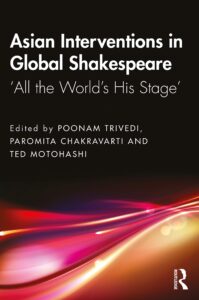 This volume critically analyses and theorises Asian interventions in the expanding phenomenon of Global Shakespeare. It interrogates Shakespeare’s ‘universality’ from Asian perspectives: how this has been modified or even replaced by the ‘global bard’ as a recognisable brand, and how Asian Shakespeares have contributed to or subverted this process by both facilitating the worldwide dissemination of the bard’s plays and challenging and resisting the very templates through which they become globally legible. Critically acclaimed Asian productions have prominently figured at premier Western festivals, and popular Asian appropriations like Bollywood, manga and anime have created new kinds of globally accessible Shakespeare.
Essays in this collection engage with the emergent critical issues: the efficacy of definitions of the ‘local’, ‘global’, ‘transnational’ and ‘cosmopolitan’ and of the liminalities and mobilities in between. They further examine the politics of ‘West’ and ‘East’, the evolving markers of the ‘Asian’ and the equation of the ‘glocal’ with the ‘Asian’; they attend to performance and archiving protocols and bring the current debates on translation, appropriation, and world literature to speak to the concerns of global and transnational Shakespeare. These investigations analyse recent innovative Asian theatre productions, popular cinematic and manga appropriations and the increasing presence of Shakespeare in the Asian digital sphere. They provide an Asian standpoint and lens in rereading the processes of cultural globalisation and the mobilisation of Shakespeare.
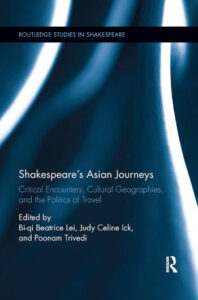 This volume gives Asia’s Shakespeares the critical, theoretical, and political space they demand, offering rich, alternative ways of thinking about Asia, Shakespeare, and Asian Shakespeare based on Asian experiences and histories. Challenging and supplementing the dominant critical and theoretical structures that determine Shakespeare studies today, close analysis of Shakespeare’s Asian journeys, critical encounters, cultural geographies, and the political complexions of these negotiations reveal perspectives different to the European. Exploring what Shakespeare has done to Asia along with what Asia has done with Shakespeare, this book demonstrates how Shakespeare helps articulate Asianess, unfolding Asia’s past, reflecting Asia’s present, and projecting Asia’s future. This is achieved by forgoing the myth of the Bard’s universality, bypassing the authenticity test, avoiding merely descriptive or even ethnographic accounts, and using caution when applying Western theoretical frameworks. Many of the productions studied in this volume are brought to critical attention for the first time, offering new methodologies and approaches across disciplines including history, philosophy, sociology, geopolitics, religion, postcolonial studies, psychology, translation theory, film studies, and others. The volume explores a range of examples, from exquisite productions infused with ancient aesthetic traditions to popular teen manga and television drama, from state-dictated appropriations to radical political commentaries in areas including Japan, India, Taiwan, Korea, Indonesia, China, and the Philippines. This book goes beyond a showcasing of Asian adaptations in various languages, styles, and theatre traditions, and beyond introductory essays intended to help an unknowing audience appreciate Asian performances, developing a more inflected interpretative dialogue with other areas of Shakespeare studies.