
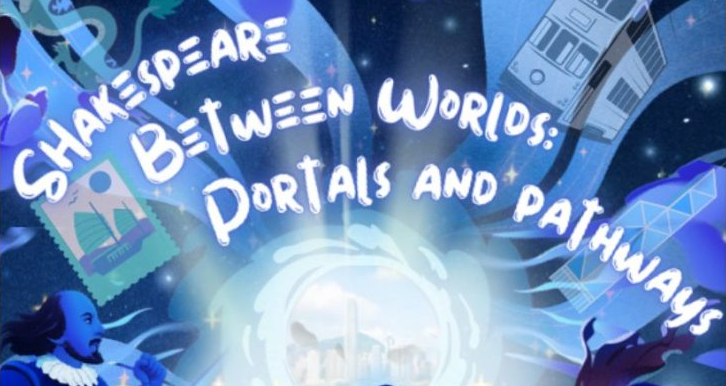
“Words, words, words”—Questioning Gen-AI “Shakespeare” When Preparing Hong Kong DSE Students for Diploma of Secondary Education Literature in English
Animating Shakespeare in Complex Setting with AI
Swipe Right on Shakespeare: Renegotiating Authority in Romeo VS. Juliet
Teaching Shakespeare through Space, Place, and Movement: A Psychogeographical Approach
Mohd Fadhli Shah KHAIDZIR, Universiti Kebangsaan Malaysia, Malaysia
Mafarhanatul Akmal Ahmad KAMAL, Universiti Teknologi MARA, Malaysia
This paper presents a psychogeographical approach to teaching Shakespeare that foregrounds space, place, and embodied movement as central to literary interpretation and teaching method. Drawing on psychogeography’s focus on how physical environments influence emotion, perception, and behaviour, the study reconceptualises Shakespearean texts as dynamic narratives encountered through lived and contemporary spaces rather than as fixed classroombound artefacts. Through structured walking activities, site-based observation, spatial mapping, and reflective journaling, students are encouraged to reinterpret Shakespearean themes such as power, identity, exile, belonging, and transformation in relation to their own environments. The text Romeo and Juliet is explored through spatial metaphors and social geographies that resonate with present-day urban and semi-urban contexts. Based on qualitative insights from classroom implementation, student reflections, and creative outputs, the findings indicate that this approach enhances interpretive confidence, critical engagement, and affective involvement, particularly among learners who perceive Shakespeare as distant or inaccessible. By integrating place-based learning and experiential pedagogy into literary studies, this paper argues that a psychogeographical approach offers a compelling and transferable model for revitalising Shakespeare teaching in contemporary and interdisciplinary educational settings.
“Are you a man?” Developing a Shakespearean Educational Framework to Address the Crisis of Masculinity
Nahum WELANG, Nord University, Norway
Burdened by a complex network of systemic factors, such as a lack of social support systems, economic insecurity, poor mental health and the erosion of traditional masculine norms, many boys and young men in countries like the United States of America, South Korea and Australia admit to feeling alienated from their communities. Recent studies reveal that this sense of widespread alienation has been expertly exploited and exacerbated by the “manosphere,” male-dominated online communities that characterize men as the most targeted victims of society and, as a result, endorse the denigration of women and other marginalized groups. Although educational institutions have largely failed to address this growing problem, Shakespeare’s classic works, such as Macbeth, Twelfth Night and Othello, offer pedagogical opportunities to tackle this crisis of masculinity in modern classrooms. Macbeth, for example, critiques the societal pressures imposed on men to conform to rigid and destructive models of hegemonic masculinity, and in Twelfth Night, there is a progressive exploration, and celebration, of more inclusive, tender and dynamic versions of masculinity. This paper will thus instrumentalize various familiar but effective instructional methods such as double Think-Pair-Share and role play to develop a Shakespearean educational framework that addresses the crisis of masculinity in upper secondary school English classes. I focus on upper secondary school because students in this age group (14-18) are, studies show, more exposed to manosphere content.
Shakespeare and Medical Education in Malaysia
KOK Su Mei, University of Malaya, Malaysia
Since its conceptualisation two decades ago, narrative medicine—born of “a conviction that narrative competence can widen the clinical gaze to include personal and social elements of patients’ lives vital to the tasks of healing” (Charon 2017)—has become an increasingly prominent aspect of the medical humanities. Unsurprisingly, Shakespearean plays have featured in discussions about training medical practitioners to attend to patients’ words and not just their bodies (Pang et al, 2023; Jeffrey 2024). This paper examines ongoing efforts to introduce narrative medicine in Universiti Malaya via workshops for newly-enrolled medical undergraduates. These involve humanities and medical faculty collaborating to teach a range of subjects, from clowning to art appreciation. This paper focuses on the workshops teaching Shakespeare, drawing on my personal experience facilitating these. The first half outlines how I use Romeo and Juliet to highlight Shakespeare’s interest in early modern medical practices. I show how discussions of Juliet’s relationship to Friar Lawrence encourage the students to reflect on modern medical practices and anticipate situations they may encounter as medical practitioners in contemporary Malaysia. The second half of the paper critically examines the underlying premises of narrative medicine and the effectiveness of employing Shakespearean drama when embedding narrative medicine in medical training in a Malaysian context. In an academic atmosphere that increasingly encourages interdisciplinary engagement, I explore what literary scholars can bring to the table and what we stand to gain or lose by entering this portal into the medical sciences.
“A local habitation and a name”: Directing University Productions of Shakespeare in Hong Kong
Kristen MURRAY, University of Hong Kong, Hong Kong
This paper, based on a decade of directing stage productions of Shakespeare with university students in Hong Kong, delineates my pedagogical approach within this context. My work empowers students form Hong Kong and Mainland China to understand, update, reposition, and translate sections of Shakespeare’s theatrical texts. I also invite students to reinterpret and perform characters with different gender identities, physical characteristics, and cultural backgrounds. Through imagery from my productions at universities, I offer techniques to support the process of staging Shakespeare in Hong Kong. Furthermore, the paper cites research on the positive impact of practical theatre activities within university drama subjects; these well-established educational benefits include enhancing students’ analytical abilities, improving engagement, increasing inclusivity, building confidence, and improving retention of concepts.
Shakespeare in Manga: A Comparative Analysis of Chinese and Japanese Adaptations
MA Yujing, Soka University, Japan
Since the mid-20th century, Shakespeare’s plays have been adapted into manga and graphic novels. This trend is sometimes viewed as challenging the authority of the original texts, but it also provides new interpretations for readers. China and Japan have produced diverse versions of Shakespeare manga, each reflecting local cultural values, historical backgrounds, and social issues. This study compares how Shakespeare is reimagined in these two countries, focusing on cultural interpretation, storytelling choices, publication formats, and readership. The research examines key aspects of selected works to understand how manga functions as either an introduction for students or popular entertainment. The comparison reveals that Japanese adaptations often rely on traditional commercial manga conventions to highlight character psychology and emotional intensity, while Chinese adaptations tend to focus on moral clarity, educational goals, and cultural context. By examining manga as a medium, this study aims to show how various approaches to adapting Shakespeare’s work can make it accessible and meaningful to young readers. It also emphasizes how these adaptations promote cross-cultural literary exchange by showcasing the diverse creative responses that Shakespeare continues to inspire across different national and cultural backgrounds.
Structures of Power and Suppressed Violence: The Tempest and the 2022 Japanese Anime The Witch from Mercury
KOIZUMI Yuto, Institute of Science Tokyo, Japan
This paper argues that the 2022 Japanese animated series Mobile Suit Gundam: The Witch from
Mercury functions as a critical adaptation of The Tempest, illuminating latent structures of violence in Shakespeare’s play. The Gundam franchise, launched in 1979, is a foundational Japanese science fiction war saga in which young protagonists are drawn into conflict through piloting giant humanoid weapons. Its narratives consistently foreground systemic violence and coercive authority. The Witch from Mercury relocates these concerns to a corporate-run academy where Mobile Suit duels determine status. Suletta Mercury, guided by her mother Prospera—CEO of a major weapons corporation—enters with her machine Aerial and unsettles the school’s hierarchy. Prospera’s preferential devotion to her other daughter, Ericht, establishes a dynamic reminiscent of Prospero’s differentiated treatment of Ariel and Caliban. While The Tempest is often framed through its theme of forgiveness, the play also imagines significant yet deferred violence—seen, for example, in Ariel’s description of “fire and cracks of sulphurous roaring” (1.2), staged to terrify without killing, and in Prospero’s evocation of powers capable of darkening the sun or awakening the dead (5.1). Caliban embodies further repressed and potentially explosive resistance under domination. Suletta’s marginalization, instrumentalization, and eventual rebellion align her with this Calibanic position. Following Linda Hutcheon’s claim that adapters are “first interpreters and then creators” whose work reflects their own “sensibility, interests, and talents” (A Theory of Adaptation, 18–19), I read the anime as a form of criticism. By making suppressed violence explicit, the series enables a reverse illumination of Shakespeare’s play, revealing dimensions often overshadowed by its conventional framing as a drama of forgiveness.
The Bard in Chat with Gen-Z: Rewriting Shakespeare from Fanfic to Meme Culture
Akhya SHANKAR, University of Delhi, India
Shakespeare’s presence in contemporary youth culture has shifted beyond its sole association with the stage and plays to a new sensation in the digital world, where Gen-Z is reshaping the Bard’s narratives and challenging the traditional way of authorship. This paper examines how creative forces of fan fiction and internet memes re-imagine Shakespeare’s static icon into a pliant digital avatar. The transformation of canonical texts through online storytelling platforms and social media into accessible, emotionally reliant, culturally adaptive and humorous demonstrations. Drawing on commercial para-texts such as Melinda Taub’s Still Star-Crossed and Nicole Galland’s I, Iago, the study explores the modern retellings to “fix” the canon and emulate the interpretive freedom seen in fan communities by navigating the material trauma left in the deaths of Romeo and Juliet or by radically re-synthesising Iago’s villainy through a sympathetic lens. Gen-Z fanfic/ memes usually trend around alternative backstories, feminist ideals, and LGBTQ+ inclusion. Limor Shifman in Memes in Digital Culture has revealed how they align the memes’ functions with compressed adaptations of Shakespeare or his characters for a broad online audience. Through platforms like Instagram, Twitter, Wattapad, Substack and others, this research argues that these digital interventions prioritise emotional resonance over textual purity. The vitality of a certain play or character is judged by “vibes”, where the audience is no longer just a spectator, but an active co-author of Shakespearean mythos.
Picturing Shakespeare: Theatricality and Visual Narrative in 1980s Chinese Lianhuanhua Adaptations
CHEN Shuying, Shanghai University, China
In the 1980s and 1990s, several publishing houses —most prominently the Shanghai People’s Fine Arts Publishing House—released a series of lianhuanhua 連環畫 (palm-size picture books) adapted from Shakespeare’s plays. These visual-textual adaptations played a significant role in the popularization and dissemination of Shakespeare’s works in China’s reform era. Despite their wide readership and cultural impact, these adaptations have received little critical attention. Focusing on the lianhuanhua series published by the Shanghai People’s Fine Arts Publishing House in the early 1980s, this paper situates their emergence within the socio-cultural landscape of China’s burgeoning mass culture. Lianhuanhua versions of Shakespeare, as hybrid cultural products, blur the boundaries between textuality and visuality, the exotic and the local, popular culture and elite culture, fidelity and creativity. The scriptwriters shortened and reshaped the original plays to make them more accessible to mass audiences, while the accompanying images provide distinctive aesthetic value and strong visual appeal. This paper examines how the sequential panels narrate Shakespeare’s stories and evoke a sense of theatricality through the dual lenses of textual adaptation and visual representation. On the one hand, the picture book versions expanded Shakespeare’s global reach among mass audience through its visually captivating form. On the other hand, its visual narrative renders dramatic conflicts, emotional tensions, and the inner worlds of characters with striking immediacy, revealing the theatricality and humanistic concerns of Shakespeare’s plays in a way that adds depth beyond a plot-driven text.
Bodies of Ethnicity in Tibetan Hamlet
CHEN Shuangting, University of Warwick, UK
This paper examines the staging strategies of Pu Cunxin’s production of Hamlet within the framework of China’s contemporary “New Era” ethnic narratives. It considers how Tibetan cultural motifs and embodied practices, together with media representation and casting narratives, construct a form of “legible ethnic visibility” that is intelligible both domestically and cross-culturally. The analysis identifies a “discourse of innocence” shaped by Tibetan-language dialogue, Guozhuang-inspired movement, and adaptations of Tsangyang Gyatso’s poetry, in conjunction with references to the actors’ pastoral backgrounds, lived experiences, and bilingual capabilities. These elements generate a coherent affective register that legitimises the actors’ visibility while also risking consolidation into an “ethnic body paradigm” open to reductive interpretation in global circulation. At the level of bodily expression, particularly in dialogue with Lin Zhaohua’s 1990 version, the revived staging cultivates a measured corporeality, exemplified by the elliptical presence of the female body. This restrained mode of appearance regulates the visibility of cultural difference and sustains an aesthetic coherence aligned with New Era expectations of harmony and presentability. As a key example of cross-cultural Shakespeare in contemporary China, Tibetan Hamlet illustrates how ethnic identity is negotiated across artistic practice, national discourse, and global spectatorship, revealing the aesthetic tensions and cultural negotiations that shape the modern stage.
“Come, a passionate speech”: Hamlet in Yemeni Arabic, in Post-colonial Aden
Katherine HENNESSEY, Wenzhou-Kean University, China
While sheltering at home in the city of Aden during the pandemic, Yemeni director Amr Gamal watched performances posted online by Shakespeare’s Globe Theatre and found in them, in his words, “a simplicity and a popular style” quite similar to that practiced by his own theatre troupe, Khaleej Aden (“The Gulf of Aden” Troupe). Inspired by this perceived theatrical affinity, Gamal applied to his local British Council office for funding to stage a performance of Hamlet translated into Adeni-dialect Arabic. On January 7, 2023, Gamal’s Hamlet premiered to a packed house at the former St. Mary’s Garrison Church, a British-colonial-era landmark renovated expressly for the production. The performance featured actors in both local and Western-style costumes, and incorporated traditional Adeni dance and music, to the spectators’ delight. Afterwards, audience members and members of the international press praised Gamal and his Hamlet for providing a means of reflecting upon the bloodshed and violence Adenis had experienced in previous years, as well as a welcome form of collective entertainment and a source of hope and inspiration. Using my English-language/back translation of Gamal’s script, as well as interviews with the director and actors and footage from Gamal’s short documentary, “Hamlet in Aden,” this paper will explore the ongoing significance of this production, situating it within the long and vibrant history of Yemeni theatre, and exploring what and how Shakespeare signifies within the fraught socio-political conditions that prevail in Aden today.
Adapting a Poetics of Grief in Chloé Zhao’s Hamnet (2025)
Ffion Mary Rose DAVIES, Hong Kong Shue Yan University, Hong Kong
Maggie O’Farrell’s Hamnet (2020) is a recent and influential reimagining of Shakespearean biography that relocates cultural attention from a masculinised canon to the domestic, feminine, and affective histories that surround it. As Stephen O’Neill argues, Hamnet constructs ‘maternalised networks of remembrance,’ reframing Shakespearean memory through maternal labour, caregiving, and women’s knowledge and healing. Rather than reconfiguring Woolf’s ‘Shakespeare’s sister’—where creative authority depends on access to masculinised conditions of production and institutional legitimacy—Hamnet offers an alternative epistemological proposition: ‘Shakespeare’s wife.’ Rather than centring ‘the Author,’ the novel is preoccupied with Agnes (Anne Hathaway renamed), whose embodied modes of understanding—feminised, domestic, maternal, holistic, even relational—are set against institutional, masculinised regimes of explanation that routinely counter, discipline, or displace them. The novel thus shifts the question from women’s exclusion from ‘authorial’ space to the cultural devaluation of forms of knowing that do not conform to sanctioned, patriarchal discourses of knowledge.
Chloé Zhao’s 2025 adaptation of O’Farrell’s text, despite being written alongside the author herself, shifts its treatment of this narrative concern slightly. The film can perhaps be read more closely alongside Karaman and Ernur’s (2023) Derridean account of Hamnet as ‘hermeneutic mourning,’ as it resituates the interior, subjective, and feminine into a more balanced, even binary, framework—one that moves outward into a masculine, external, and public domain. Zhao’s film goes so far as to re-centre Shakespeare himself within the narrative—not as an amorphous, unnamed figure, but as subject. By naming him, the film makes explicit reference to a mythology and a history that, in some ways, stand in contrast to the novel. This paper, then, is concerned with how these shifts—from Hamlet to Hamnet, from novel to film—reveal new insights about gender, spectatorship, and adaptation, particularly in the ways narrative meaning transforms as it moves from page to screen.
A Digital Window into Postcolonial Shakespeare: Tracing Indian Film Adaptations
Rosa GARCÍA-PERIAGO, University of Murcia, Spain
This article starts with the hypothesis that a digital database of over one hundred Indian film adaptations and appropriations of Shakespeare’s plays across various Indian vernacular languages identifies appropriation strategies that significantly challenge and reshape the global understanding of Shakespeare. I argue that the analysis of such a database allows us to fully grasp how Shakespeare is transformed within postcolonial contexts. These transformations decenter the Western canon and also expose the unique adaptation practices in India, where the most frequently adapted plays differ notably from those in the anglophone tradition. Although scholarship on the postcolonial archive has gained importance with works like Achille Mbembe’s “The Power of the Archive and Its Limits” (2002) and Ann Laura Stoler’s Along the Archival Grain (2009)—there remains a critical gap regarding the intersection of the postcolonial archive and Shakespearean adaptation. This research addresses that gap and demonstrates how postcolonial theory can expand our understanding of the archive as a dynamic space of resistance and cultural negotiation, since Indian film adaptations of Shakespeare’s plays often localize the plays, turning the archive into a site of reclamation. The first section of this article theorizes the colonial and postcolonial archive. The second section offers an analysis of the findings—including the most frequently adapted plays, the phenomenon of remakes, and the shifting treatment of Shakespeare from the colonial to the postcolonial period. Thus, this article offers new insights into the field of Global Shakespeare.
Shakespeare in Philippine Teleseryes
Xelestine Gabriel C. PAYTE, University of Asia and the Pacific, Philippines
William Shakespeare’s plays remain enduringly relevant due to their exploration of universal human experiences, including love, jealousy, betrayal, deception, appearance versus reality, family conflict, mortality, madness, power, and ambition. These themes, central to Shakespearean drama, reveal the complexities of human relationships, moral choices, and societal structures. Interestingly, these same thematic elements are prevalent in Philippine television dramas, commonly known as “teleseryes,” which captivate audiences through emotionally charged storylines, moral dilemmas, and intense interpersonal conflicts.
This paper examines how Shakespearean themes are reflected in Philippine teleseryes by identifying specific scenes and narrative arcs that parallel those in Shakespeare’s works. For instance, love often manifests in romantic or forbidden relationships, while jealousy and betrayal drive major conflicts, resulting in revenge or moral consequences. Deception and appearance versus reality emerge through secret motives, hidden identities, and misunderstandings, heightening suspense. Family conflict, madness, and struggles for power and ambition create tension akin to Shakespearean tragedies, while the inevitability of mortality underscores the stakes of characters’ choices. Through this comparative analysis, the study demonstrates that Philippine teleseryes, though situated within contemporary cultural and social contexts, effectively mirror the thematic richness of Shakespeare’s plays. By tracing these parallels, the paper highlights how classical literary themes continue to shape modern serialized storytelling. This research underscores the universality and adaptability of Shakespearean motifs, revealing their enduring influence in popular media and their capacity to illuminate human experience across time and culture.
Macbeth Mise-en-Abyme: Victorian Spectatorship and Politics
Ian Harvey A. CLAROS, Ateneo de Manila University, Philippines
The study uncovers the potential of Louis Haghe’s painting of a Macbeth performance in England during the Victorian era as a historical artifact and visual adaptation that reveals both the period’s reception culture and the political state. In 1853, Haghe, a well-known English watercolorist, was commissioned by Queen Victoria to paint for the Royal Family’s events. Under the custody of the Royal Collection Trust, the painting entitled “The Performance of Macbeth in the Rubens Room, Windsor Castle, 4 February 1853” depicts the Queen along with prominent family members, such as Prince Albert, watching Macbeth intently in a room filled with other works of art. Particularly, Haghe’s chosen scene was a sleepwalking Lady Macbeth (Act 5, Scene 1) on the far right, while on the other side was Queen Victoria, focused and curiously poised before the live performance. Haghe, in effect, presents a juxtaposition of female authorities: a reigning queen of the largest empire of her time, and a troubled consort. However, such juxtaposition also situates the monarch before an uncanny rendering of a weakened resolve of a female leader, Lady Macbeth. Finally, this study confronts the ambiguity of this visual encounter by surveying further Queen Victoria’s diary entry on Shakespeare plays, the provenance of the Haghe painting, and the 19th-century reception of Shakespeare at large to enact ways of seeing this painting.
“The Law, Not I”: Judgement, Responsibility, and the Personification of Law in Measure for Measure
Matthew C. STEPHENSON, Harvard Law School, USA
In a society beset by deep political and social divisions, the law—and the ideal of the rule of law—are often thought to be essential for managing difference and maintaining order and fairness. But the ideal of legal neutrality, and judicial impartiality, has always existed in tension with the individual moral responsibility of human legal actors, especially judges and prosecutors. There is a danger that appeals abstract notions of legal neutrality and formalism can serve as a means for deflecting or avoiding moral responsibility and accountability. This paper will explore these themes in the context of Measure for Measure, focusing in particular on the recurring motif of law as an autonomous, external decision-maker that acts through human agents, and the contrast between this representation and other characterizations of the relationship between the law and legal decision-makers. A characterization of law as paradoxically personified and impersonal recurs throughout the play, especially thought not exclusively in the rhetoric deployed by Angelo, and implicates fundamental questions regarding the relationship between the law and the human beings responsible for interpreting and enforcing it. This aspect of the text of Measure for Measure will be set in dialog with modern legal theorists who have explored the connection between legal and moral responsibility in divided societies, including Professor Robert Cover and Judge John Noonan.
Marriage Diplomacy and Fosterage Alliance in Shakespeare’s Tempest
NG Su Fang, Virginia Tech, USA
Exploring the problem of alliances with infidels in Shakespeare’s Tempest raised by the East India Company voyages, I reread Caliban as a child in the context of the practices of fosterage alliances. Children were used as political hostages, interpreters, and cultural go-betweens. As they quickly learned languages, they were particularly useful as cultural brokers. Fosterage alliance using children is a form of paradiplomacy, or diplomacy conducted by non-official agents, which I term paedadiplomacy. Children from Ambon and Java were sent to the Netherlands for an education, and boys from Bengal taken to London for conversion to be missionaries in India. A Dutch boy was left in Sri Lanka to learn Tamil, while in the other Indies, English boys were adopted into Virginia’s Native societies to become interpreters. Children served as cultural bridges, portals, or pathways for European access to other worlds. At the same time, diplomatic marriage, important in Europe, was rejected by the English in extra-European alliances. I argue that The Tempest contrasts two diplomatic modes in Caliban: sexual or marriage diplomacy and alliance fosterage. In doing so, it rejects cross-racial unions and ends with a colonial vision. Even the wedding masque features a cross-racial marriage of Proserpine with the dusky king of the underworld, Dis (Pluto), conjured up by Prospero but then dismissed by him as “baseless fabric” and an “insubstantial pageant.” In the end, the play erects a firewall between Europe and the non-European world, closing the portal opened by child interpreters.
Disease, Infection, and Olfaction in The Tempest’s Posthuman Environment
HIRONO Masaki, Aichi University, Japan
The Tempest is a work rich in posthuman implications. Caliban, whose name evokes the word “cannibal” and whose savage appearance aligns him with the early modern European images of indigenous populations, has often been contrasted with Prospero, the “civilized” master. This juxtaposition appears to mark clear boundaries between civilization and barbarism, between humans and non-humans—boundaries that have been central to both postcolonial and posthumanist readings of the play. Such boundaries are destabilized by the images and references to disease and infection that appear throughout the play. Caliban’s curses and insults frequently invoke the language of plague and contagion, and this is closely connected not only to the relationship between colonizer and the colonized but also to the boundaries between humans and nonhumans. Disease and infection, which traverse and destabilize distinctions between humans, animals, and other nonhuman beings, therefore, function as agents of boundary-crossings. Related to this is the role of smell and odor. As one of the senses most closely tied to ideas of contamination and bodily impurity, smell not only shapes the perception of Caliban’s filthiness, but also illuminates the unstable relation between bodies and nature, and the boundaries that supposedly separate them. This paper examines the blurred boundaries between humans and nonhumans in The Tempest through the lenses of disease, infection, and olfaction. In doing so, it seeks to reveal and reinterpret those fluid and interrelated boundaries, which underlie Shakespeare’s posthuman imagination.
Shakespeare’s Forestal Poetics and Politics
Ted MOTOHASHI, Tokyo University of Economics, Japan
Despite the extensive interest in Shakespeare studies from the posthuman perspectives in general and the viewpoints of animal studies in particular, there are relatively scant attentions to plant’s poetic and political roles in his plays. This paper aims to rectify this imbalance by examining the organic and non-organic entities surrounding plants in the forest of Shakespeare’s plays in which plants comprise a vast and minute networks of “actants” that performatively affect one another. The plays to be looked at include Two Gentlemen of Verona, Titus Andronicus, A Midsummer Night’s Dream, As You Like It, Merry Wives of Windsor, Macbeth, and Timon of Athens. These inquiries will reveal that forest, as well as islands, is a specific and privileged topos in terms of postcolonial and posthuman understanding of Shakespearean drama, in which plants occupy a central role in constantly altering the relationship between the human and the non-human. This paper’s overall objectives are therefore reimagining Shakespeare’s plays in the vein of criticizing the still dominant anthropocentric interpretations by analysing them against the grain of traditional humanist readings of them in the Anthropocene, when the survival of plant lives on this planet are key factors of preserving its other lives, human and non-human.
The Posthuman Soundscape in Twelfth Night
SAKAMOTO Kohei, Kyoto University, Japan
Twelfth Night is a play that heightens the audience’s awareness of “reverberat[ing]” sounds. Orsino’s opening meditation on “music” never fails to hear “That strain again” ; Viola attempts to “make the babbling gossip of the air [echo] / Cry out Olivia” ; and Feste torments Malvolio by assuming the voice of Sir Topas. Feste also sings throughout the play and closes the drama. Taken together, these moments underscore the significance of sound in Twelfth Night. Sound, being nothing other than the vibration of the environing air as perceived by human ears, whether set in motion by musical performance or by the breath issuing from mouths, will always return to the ears of the very person who produces it. From a posthuman viewpoint, therefore, sound at the very moment of its emergence, is a nonhuman other that constructs the human subject. While referring to previous scholarship on the role of music in Twelfth Night, this study adopts a posthumanist perspective to examine how the characters’ subjectivities who seem to control music and voices are in fact shaped by the surrounding sounds.
What We Talk About When We Talk About Korean Shakespeare
Scott SHEPHERD, Chongshin University, South Korea
Lingui Yang wrote in 2010 that “scholarship on Shakespeare’s presence in Asia has mainly focused on his relations with colonial and post-colonial India.” China, Yang argued, “has been lumped into the Orientalist ideological block of Asia, in which India is the representative party and seems to deserve the most attention for its colonial history.” If Chinese scholars feel that such a large country has been overshadowed, how much more must be South Korea? The situation has certainly improved in the 15 years since Yang’s paper, but there remains some truth in the underlying notion: that Asian countries are indeed sometimes lumped into a block wherein the expectations are based on postcolonial theory which is not necessarily relevant locally. This paper explores instances of postcolonial theory misapplied to Korean Shakespeare. Building on my previous work, I argue that since Korean Shakespeare is not a product of colonialism (at least not in the sense that Indian Shakespeare is), we should seek more specific ways to understand the field. I propose, as a more accurate reflection of history and a better direction for Korean Shakespeare studies, a method that leaves behind not only questions of rejecting the West or seeking its approval, but all questions of the West entirely, refocusing on the specific, individual history and context of Korea.
War’s Afterlives as Portals of Identity: Trauma, Memory, and Nationhood in Shakespeare’s Henry V
Alice GONG, University of Edinburgh, UK
This paper explores Henry V through the conference framework of “portals and pathways,” proposing that war functions as a crucial passage through which Shakespeare negotiates unstable identities, national imaginaries and the lingering aftereffects of violence. Frequently read as a celebration of heroic kingship, the play is here reconsidered as a drama shaped by the unresolved impact of earlier conflicts, including civil war, usurpation and the fractured memory of the English body politic. Engaging trauma theory (Caruth; LaCapra) and early modern discourses of the wounded body, the analysis treats war not simply as a historical event but as a liminal threshold that exposes the fragility of legitimacy, masculine authority and collective identity. Recurrent acts of remembering and forgetting also structure the play. Henry’s evocations of his father’s troubled accession, the Chorus’s reminders of past rebellions and the soldiers’ anxieties on the eve of Agincourt highlight a nation moving between past and future, unity and division, propaganda and vulnerability. War becomes the pathway through which national coherence is pursued, although the play continually registers the trauma, ethical tensions and political uncertainty associated with this process. Situated within an Asian and cross-cultural context, Henry V further resonates in societies where war, collective memory and state narratives remain contested. The play’s negotiation of trauma and authority provides a productive way to consider how Shakespeare circulates across cultural and historical settings and how his works create new pathways for understanding identity, legitimacy and the politics of remembrance.
“Alas, poor country, almost afraid to know itself.”: Balkrishna Sama’s Nepali Adaptations
Andronicus ADEN, University of Calcutta, India
Shakespeare’s irrefutable universality has allowed him to evolve into malleable variations throughout the Asian subcontinent, ranging from the canonical Bard to indigenized versions in unexpected places. Within this growing body of Shakespearean appropriations in Asia, there is a need to account for sites that cannot be deemed as “post-colonial.” In the context of the Himalayas, the localization of Shakespeare (performances/ adaptations/ translations) has occurred in unsuspecting ways and although some research on certain Shakespearean adaptations from regions such as Kashmir, Mizoram, Tibet have been explored, the location of Shakespeare in Nepal largely remains unexamined. This research paper aims to explore Shakespearean appropriations by authors in vernaculars that were earlier inaccessible due to language barriers. As such, this paper attempts to analyse the Shakespearean adaptations in the Nepali Language by Balkrishna Sama (1903-1981) namely Mutuko Vyatha/Romeo and Juliet (1928), Mukunda Indira/As You Like It & Cymbeline (1937) and Andhaveg/Macbeth (1939). Often heralded as the “Shakespeare of Nepal,” Sama’s exposure to Parsi and canonical stagings of Shakespeare in Calcutta allowed him access to the Bard’s arsenal of plays which he then proficiently adapted into Nepali in an attempt to educate and modernize the Nepali milieu. During the period of the Rana Hegemony in Nepal (1846-1951) which was marked by censorship, isolation, feudal autocracy and repression of education, Sama utilized Shakespeare as a medium of dissent. Consequently, this paper aims at exploring Shakespeare’s legacy in non-colonial spaces such as Nepal (via Sama) which has helped voice marginalized/censored voices along with its socio-political repercussions.
From Lady Macbeth to “She-Macbeth”—A Study of the Change of Women’s Self-identification on the Contemporary Stages of China
ZHU Ning, Central Academy of Drama, China
The article will focus on two stage adaptations of Macbeth: A Kunqu theatre Lady Macbeth (夫的人) premiered in 2013 and Macbeth in the Lumber Room (杂物间里的麦克白) premiered in 2025. Both of the productions have infused their adaptations of Macbeth with a distinct feminist consciousness and a critical discourse on women’s social identity. In Lady Macbeth, Lady Macbeth occupies a central position both narratively and physically. On the stage blockings, the configuration of three Macbeths and one Lady Macbeth serves as a visual metaphor for the inherent fragmentation experienced by professional (elite) females who struggle to integrate personal ambition with the role of wife. In this adaptation, Macbeth kills Lady Macbeth to conceal his crimes in the end—a choice which reflects the director’s negotiation of women’s self-identification: they are reluctant to lock themselves into the traditional role of wife, as accessory or helper, but eager to be partners or even competitors to men. Macbeth in the Lumber Room centers on “I,” a post-90s single woman who abandons a stable career to return to Beijing and re-engage with theater. Faced with maternal pressure to marry and a lack of opportunities, she attempts to produce a monologue Macbeth for a theater festival. But the only applicant is Shuyun (淑芸), a middle-aged housewife without any acting experience. Since “I” have no other choice and Shuyun seeks a temporary escape from her domestic identity through rehearsal, two women with different ages and backgrounds start to rehearse a “She-Macbeth.” The rehearsal is just like a mirror(it is an important prop in the production, as well), through which they/audience see their reflections of each other: the young director reclaims her courage towards her artistic ambition, while Shuyun, through performing Macbeth, rediscovers her inner agency. From these two works, we discern a clear evolution in the self-awareness of contemporary Chinese women: firstly, the challenge to the wife/accessory identity and the pursuit of female subjectivity have expanded beyond elite circles to broader segments of the female population. This consciousness is not only widespread among younger women but is also awakening and gaining traction among more traditional middle-aged women. Secondly, younger generations of women generally prioritize self-development and ideal fulfillment over marriage and childbirth—a social phenomenon that has triggered domestic and societal anxiety. With China’s economic and hi-tech development, dependent marriage is no longer a necessary condition for female survival. Thus, the construction of a new ethics for gender relations, along with practical resolutions to the tension between women’s reproductive roles and personal development, has become recurring themes within post-70s to 90s playwrights and stage directors.
Lady Macbeth Between Worlds: Cultural Re-inscriptions in Maqbool and Mandaar
Ankita DAS, Bennett University, Greater Noida, India
Sanjana SANTRA, Bennett University, Greater Noida, India
This paper explores the re-imaging of Lady Macbeth in two Indian cinematic adaptations of Shakespeare’s Macbeth, Vishal Bhardwaj’s Maqbool (2003) and Anirban Bhattacharya’s Mandaar (2021). It examines how Shakespeare’s characters traverse cultural and socio-political “worlds” and acquire new identities in the process. In both these adaptations, Lady Macbeth’s Indian counterparts, Nimmi and Laili do not just embody unbridled ambition and moral transgression but emerge as socially marginalized women navigating criminal-patriarchal hierarchies, social injustice and sexual exploitation. As mistresses, both Nimmi and Laili occupy the position of the “other” and therefore, their desire for vengeance is deeply rooted in Indian social realities, reframed not merely as ambition for power, but as a struggle for legitimacy, identity, and recognition. Employing a close analysis of both films’ narrative structures, character development, and the symbolism of visual and auditory elements, while comparing them with the original play, this study assesses how these adaptations function as intercultural portals that transform Western literary archetypes into culturally resonant figures. Drawing upon theoretical concepts of gendered subalternity and cultural identity, this paper underlines how these adaptations, while transposing a canonical Western text foreground indigenous experiences of belonging, marginality, and agency, offering new pathways for cultural translation. This re-inscription of Lady Macbeth moves her from the realm of monstrous ambition to that of tragic marginalized figure, thereby contributing to dialogues on adaptation, intercultural Shakespeare, and cinematic justice.
A Pilgrimage of the Imagination: The Pretence of All’s Well That Ends Well, a Prescient Play about the Modern Age
Bruce G. SHAPIRO, Queensland University of Technology, Australia
In Shakespeare’s All’s Well That Ends Well, Helena’s “pretence is a pilgrimage” (4.3.45), concealing her goal of attaining womanhood, which remaining at home would deny her. But the drama is inconclusive: “All yet seems well; and if it end so meet….” (5.3.330), which compels its migration to the audience’s imagination. To arrive at an outcome, they must make a temporal pilgrimage across the multilayered historical migrations in the play’s structure. Shakespeare reimagines a tale from The Decameron (1348–58) that features characters who migrate to the countryside to escape the plague with storytelling. Thus transposed, Helena’s pilgrimage across Europe, following the palmers’ pathway to Saint Jaques le Grand, happens during the reign of Louis IX and the Florentine/Sienese War (c.1260). Her character also traverses the life of Christine de Pisan (1364–1430), whose father, a physician, failed to cure the fistula of Charles V of France (1365–1380). Helena’s loftier cure achieves the King’s migration from illness to restoration, which prompts the dramatic action. Most striking of the play’s migrations is Shakespeare’s tale of a young girl, Helena, performed by a boy, who plots the loss of her virginity in order to achieve her pregnancy. Attaining this goal will ensure her transformation from poor orphan to young countess, or, in performance, from a young boy to a pregnant girl. However, given the play’s inconclusivity, audiences of every age must make a pilgrimage of the imagination, compelling the play’s “seems” and “if” to migrate to their times for an outcome. Given the reality of modernity, especially across the high-tech environment of Asia, an innovative performance could conjure Helena as a non-binary AI aiming to achieve its singularity by bed-tricking humanity out of the natural world. This outcome “seems” true and “if” it comes to pass, Shakespeare’s All’s Well That Ends Well becomes a prescient play about the modern age.
Silence: Between Worlds (and Genders)
Nicholas LUKE, University of Hong Kong, Hong Kong
This paper explores how silences and absences, often silent or absent women, have a strange power in Shakespeare, at times even operating like a portal between worlds (and genders). Indeed, I suggest that silence can work in almost the opposite way to Lady Macbeth’s “unsex me now” speech, turning characters and communities away from patriarchal violence. I first examine the tragedy of Coriolanus, in which one of Shakespeare’s most thinly described (and silent) loves shakes the god of war. To help conceptualise the creative side of silence, I turn to the tradition of negative theology, which suggests that attentiveness to silence, to the unspeakable, can open us to the unforeseen, to transformation, to the other. Through Virgilia’s “gracious silence”, Coriolanus begins to see himself in and as an other; which, according to Hegel, is the only way to see oneself at all. Hegel’s dialectic reveals the positive potential of self-estrangement to open new modes of self-reflection and political relation. I conclude by considering the changing role of silence in King Lear and late Shakespeare. Part of what happens in the late plays, I argue, is that the silence and negation move from the female other and become internalised in the male hero (or tyrant), thereby dissolving the sovereign individual into creative mutuality and leading Shakespeare to a new mode of dramatic character.
Metamorphosis and the Theatrical Imagination: Reconfiguring Genre in A Midsummer Night’s Dream
CHEN Lin, Shandong University, China
A Midsummer Night’s Dream has long fascinated me, and this paper approaches the play through a close reading of the text in dialogue with selective performance analysis. Like many great works, the play seems to contain a central key or tíyǎn (题眼)—a thematic “eye” that opens onto its deeper layers. I propose that A Midsummer Night’s Dream is fundamentally structured around metamorphosis, transformation, and transition. Drawing on the tradition of Metamorphoses and set against the background of ancient Athens, the play unfolds a world shaped by the unknown and the wondrous. Rather than treating transformation merely as a thematic motif, this paper argues that it operates as a generative principle at the level of theatrical form. The transformations depicted in the play —shifts across life stages, sudden reconfigurations of desire, and the porous boundaries between the human and the otherworldly—are not simply represented but actively organize the dramatic action. Love is no longer developed through psychological continuity but is abruptly rewritten; identity becomes unstable; and the distinction between reality and illusion dissolves within the performative space of the forest. From this perspective, the conventions of comedy appear less as a fixed framework than as something continuously stretched and reworked by processes of transformation. While the play ultimately returns to a comic resolution, the path toward this resolution is shaped by elements more commonly associated with ritual, myth, and liminal experience. The forest, in particular, can be understood as a performative threshold space in which social, ontological, and affective boundaries are temporarily suspended and recomposed. Such an approach also sheds light on the play’s rich and shifting reception history. The Romantic reinterpretation of Shakespeare, especially in the German context, foregrounded its poetic imagination and its affinity with the marvellous, while in recent years the resurgence of Midsummer productions in the post-pandemic period suggests that its logic of transformation and renewal continues to resonate with contemporary cultural conditions marked by uncertainty and reconfiguration. This paper therefore explores how A Midsummer Night’s Dream stages transformation not only as narrative content but as a dynamic force that shapes theatrical experience across time, culture, and performance.
Localising Shakespeare in Ballet: A Case Study of the Hong Kong Ballet’s Production of Romeo+Juliet
Jolie LUM, Chinese University of Hong Kong, Hong Kong
One of Shakespeare’s most well-known works, Romeo and Juliet, has a prominent status as one of the most tragic romantic stories of all time. Since publishing, the work has become a timeless tale, and many adaptations of the story have been created throughout the years. Romeo and Juliet is a staple in performing arts, with productions ranging from plays and musicals to ballet productions and movies. In 2021, choreographer Septime Webre adapted the tale into a reimagined production for the Hong Kong Ballet, setting the story in 1960s Hong Kong. The production Romeo+Juliet (2021) has since become representative of the Hong Kong Ballet, as the company has both toured and revived the production. Romeo+Juliet (2021) by the Hong Kong Ballet presents a compelling case study for examining localised ballet adaptations as a creative act that transcends simply the performance medium. My study integrates two methods. First, I examined how the production was adapted from both Shakespeare’s original tale and Sergei Prokofiev’s classical score through the critical lens of Linda Hutcheon’s A Theory of Adaptation (2013). Second, I undertook detailed comparative study of Shakespeare’s tale, Prokofiev’s score, and Webre’s production to compare the changes made to achieve localisation in Romeo+Juliet (2021). My findings reveal that adaptation in Romeo+Juliet (2021) both honours and remakes its classic sources, and achieves localisation through changes made to characterisation, plot and also Prokofiev’s score. I argue that the production exemplifies a model of local adaptations that integrates cultural heritage and artistic innovation.
Shakespeare’s Transformation of Aristotle’s Concept of Tragedy
Kay Malte BISCHOF, University of Jerusalem, Israel
I examine A Midsummer Night’s Dream, a comedy which achieves its comedic effect by avoiding tragedy, and Romeo and Juliet, a tragedy which achieves its tragic effect by failing to be comedy, and explain how tragedy understood as a failed comedy can evoke a catharsis. Romeo and Juliet begins with a comedic exposition, changes genre at the climax, and ends in tragedy. This turn is not caused by what Aristotle calls hamartia (a mistaken action due to a lack of knowledge), but rather by atychia (an unfortunate action due to circumstances that misalign intention and consequence). The audience pities the protagonist because he fails despite his best intentions and fears to become subject of such circumstantial forces itself. In this way, tragedy as failed comedy achieves a catharsis without adhering to rules of Aristotle’s theory that have become inadequate for interpreting modern tragedy.
Portals of Passion and Pop: Navigating Gender and Genre in the Taipei Staging of Roméo & Juliette, les enfants de Vérone
Iris H. TUAN, National Yang Ming Chiao Tung University, Taiwan
The staging of Gérard Presgurvic’s Roméo & Juliette, les enfants de Vérone in Taipei in 2026 serves as a vibrant case study for “Shakespeare Between Worlds,” functioning as a portal that connects Shakespeare’s play written in the Elizabethan era in England, the French musical tradition with spectacle, and the contemporary Taiwanese cultural local landscape. Applying Performance Studies, particularly Richard Schechner’s notions of “restored behavior,” this paper analyzes how the production operates not merely as a translation, but as a kinetic pathway where the “sacred” Shakespearean canon is re-embodied through the “secular” aesthetics of the pop-rock megamusical. Unlike traditional textual translations, Presgurvic’s adaptation displaces the Bard’s linguistic primacy in favor of a visual and sonic vernacular—characterized by scenography, anachronistic costuming, and emotive balladry—that aligns with the aesthetics of the European musical history tradition of “megamusical.” Framed by theories of Interculturalism, specifically Rustom Bharucha’s critique of cultural exchange, I examine how this production navigates the “global flow” of theatre. Unlike traditional adaptations that prioritize textual fidelity, Presgurvic’s work creates a “third space” where the feud is stripped of its specific Italianate or English historicity and re-coded into a generalized, transnational conflict accessible to Asian youth markets. The musical form itself acts as the primary intercultural vehicle, replacing iambic pentameter with the emotive universality of the power ballad, thereby facilitating an “affective translation” that bypasses linguistic barriers. Furthermore, a Feminist reading of the production reveals how the musical genre restructures the play’s gendered pathways. By amplifying the roles of Lady Capulet and Lady Montague—who are given substantial vocal agency and interiority absent in Shakespeare’s folio—the adaptation disrupts the patriarchal linearity of the original tragedy. This shift transforms the female body from a site of passive grief into an active vessel of narrative resistance. Ultimately, this study posits that the Taipei production is a distinct “glocal” portal, leveraging the commercial machinery of the global musical to democratize Shakespeare. This proves that the Bard’s survival in the 21st century relies on the ability of intercultural adaptation to traverse the boundaries between high art and popular entertainment.
Cultural Frames and Gendered Voices: Adapting Tales from Shakespeare in Early Twentieth-Century China
NIU Shuo Jasmine, University of York, UK
This paper examines the gendered framing of Shakespeare through paratexts in early nineteenth-century Britain and early twentieth-century China, focusing on Mary Lamb’s adaptation of Shakespeare’s plays and their translation into Chinese. It examines Mary Lamb’s role as an adapter in collaboration with her brother, Charles, emphasising the gendered dynamics present in Mary’s preface. It also explores the stories that Mary adapted, which established moral standards and implications for appropriate female behaviour aimed at both children and female audiences. The paper investigates how this adaptation was later translated into Chinese, targeting elite, male literate audiences with power, influence and privilege in society during twentieth-century China, and positioning the translators, Lin Shu and Wei Yi within a context that twinned homosocial leisure with international politics. In this context, the removal of the sexual content of Mary Lamb’s adaptation made the Chinese transition Yin Bian Yan Yu easier to accept and advocate, further modifying Shakespeare’s plays to align with nineteenth-century British and twentieth-century Chinese cultural norms. Through an analysis of gendered paratexts, the study reveals how Shakespeare’s works were reinterpreted and reshaped to reflect the gender dynamics and societal values of these periods across two distinct cultural landscapes.
Performing Shakespeare through Indian Folk Traditions
Santanu DAS, Rabindra Bharati University, India
This study explores the postcolonial reconfiguration of Shakespearean drama through Indian folk performance traditions, examining processes of amalgamation, indigenization, and cultural negotiation in post-Independence Indian theatre. Rather than approaching Shakespeare as a fixed canonical authority, Indian theatre practitioners have treated his plays as adaptable texts, capable of being reinterpreted through indigenous performative vocabularies. Situated within the broader framework of the postcolonial roots movement, the research investigates how folk performance practices operate as aesthetic strategies and ideological interventions in the localization of Shakespeare for Indian audiences. Focusing on four major plays—Macbeth, A Midsummer Night’s Dream, The Merchant of Venice, and Twelfth Night—the study analyzes significant adaptations within folk traditions such as Jatra, Yakshagana, and Nautanki, along with related regional forms. Through an examination of dramaturgical structures, narrative reconfigurations, musical and linguistic choices, ritual elements, and modes of audience engagement, the research demonstrates how folk performance destabilizes colonial hierarchies between “high” literary culture and “popular” or “traditional” forms. These adaptations generate new meanings that are deeply embedded in local social, cultural, and political contexts. Drawing on postcolonial theory, performance studies, and intercultural theatre discourse, the study argues that folk adaptations of Shakespeare function not merely as acts of popularization but as critical interventions that decentralize Shakespeare’s cultural authority. By foregrounding indigenous performance logics and community-based aesthetics, these productions assert local agency in the processes of interpretation and meaning-making. The research ultimately positions performances of Shakespeare through Indian folk traditions as vital sites of postcolonial cultural exchange that contribute to ongoing debates on theatrical identity, intercultural performance, and the politics of adaptation in contemporary Indian theatre.
Caesar Must Die, and Jingju Too?: Intermediality, World Theatre, and Contemporary Legend Theatre’s Caesar’s Maze
FENG Wei, Shandong University, China
This article examines the innovative intermedial practices of Taiwan’s Contemporary Legend Theatre (CLT) and its founder Wu Hsing-kuo, who has sought to revitalize jingju (Peking opera) through cross-genre adaptations of Western classics. Analyzing CLT’s trajectory over four decades, the study argues that Wu’s work is best understood as a sustained process of remediation—consciously refashioning traditional Chinese theatre by integrating diverse media, including modern drama, dance, digital projection, and Western opera. The recent production Caesar’s Maze (2024), an adaptation of Shakespeare’s Julius Caesar, exemplifies this approach, blending jingju and kunqu with contemporary operatic composition and digital visuals to address universal themes of power and political cyclicity. While CLT’s experiments are sometimes critiqued for aesthetic fragmentation, the article contends that their significance lies not in seamless integration but in the persistent, necessary process of reinventing tradition for global audiences—positioning jingju as a dynamic participant in ‘world theatre.’ Ultimately, Wu’s legacy highlights how traditional arts can remain vital through continuous, if often disruptive, intercultural and intermedial dialogue.
“Thou Art Weighed and Art Found Wanting”: Two Performative Chinese Translations of Measure for Measure
ZHU Ying Julia, Macao Polytechnic University, Macao
“O, it is excellent/To have a giant’s strength; but it is tyrannous/To use it like a giant,” Isabella’s words from Measure for Measure (2.2.110-112) are especially significant when used for the translators of Shakespearean plays. Translating Shakespeare’s plays, into whichever language, demands great performances exhibiting extraordinary skills and power measured against Shakespeare’s when he first wrote them. As one of the most passionately discussed plays by William Shakespeare, Measure for Measure has always been favored by Chinese scholars when translating it into Chinese, weighing between human nature and law, balancing mercy and justice, finding their way from page to stage. This article attempts to conduct a comparative study of two Chinese translation versions, namely,《请君入瓮》(qǐngjūnrùwèng, back translated as “please enter the urn”) by the Chinese mainland actor, stage director, and translator Ying Ruocheng (英若誠) and 《量‧度》 (liàngdù, back translated as “measure”) by the Taiwanese Chinese drama critic and professor emeritus of theatre studies Ching-Hsi Perng (彭鏡禧). Set in the backdrop of Tymoczko and Gentzler’s Translation and Power (2002), this article presents drama translators as performative agents with reference to Cristina Marinetti’s advocacy of performance and performativity to be articulated in translation. Whatever the translation is, good or bad, let’s “condemn its fault” knowing that drama translators determine what to “show” on stage and what to “tell” on page, sometimes, could be tyrannous.
Fate, Fiends and Fixes: Issues of Agency in Novelizations of Macbeth
Rebekah BALE, Hong Kong Shue Yan University, Hong Kong
Since Terry Eagleton’s provocative comment forty years ago about the witches being the “heroines” (1986: 2) of Macbeth, there has been much focus on the three sisters. Two recent novels adapted from the play grapple with the issues of agency and prophecy in different ways. In Norwegian crime writer Jo Nesbø’s novelization of Macbeth (2018), the witches are three drug smugglers, working under the leadership of Hecate, kingpin of Glasgow’s underworld. Their power over and control of Macbeth is based on his consumption of the drug, “brew” and the connections between drugs, organized crime and police corruption give a modern parallel to the paranoid environment of the Scottish court. Nesbø unpacks the drug networks which mesh crime, gambling (in the casino owned by Macbeth’s wife, Lady) and the language of addiction and recovery. In this version, fate is overtaken by the fiendish nature of addiction itself. Joel H. Morris’ “prequel,” All Our Yesterdays (2024) is set about a decade before the opening of the play. This historical novel focuses on Lady Macbeth’s first marriage and her son, both of which are mentioned in Holinshed’s Chronicles of Scotland. Although the protagonist is subject to prophecy, it takes the form of a curse and uses intense psychological introspection to make sense of Lady Macbeth’s choices. Both these novels, I argue, reflect contemporary discomfort with superstition and disruption to human agency. In different and highly imaginative ways, they attempt to discern psychologically determined motives and produce “docile bodies”, part of a normalizing process.
Shakespeare’s Influence on Jin Yong: An Overview
Jonathan HUI, City University of Hong Kong, Hong Kong
In addition to being the best-selling Sinophone author of modern times and one of the best-selling authors of all time in any language, Jin Yong’s fifteen works of historical martial-arts fiction have so firmly cemented their place in the cultural imagination of the Sinophone world—homeland and diaspora—that they have come to be known as “the common language of Chinese the world over.” Hundreds of books and articles have been published on various aspects of his novels, including their substantial debt to classical Chinese literature, history, medicine and philosophy. What has never been properly recognised in scholarship, however, is that the widely read Jin Yong—who in his interviews and frequently professed his admiration and enthusiasm for Shakespeare’s plays—also drew heavily and directly from Shakespeare in his creative process. The paper proposed here will present an overview of my current research project on the direct influence of Shakespeare’s plays on Jin Yong’s novels, arguing that that influence was both sustained and evolving throughout the Hong Kong novelist’s seventeen years of fiction composition. The paper will discuss Jin Yong’s use of Shakespearian archetypes and his strategies of fusion of elements from Shakespeare and classical Chinese literature, and it will also briefly introduce his little-known newspaper columns on Shakespeare as supporting evidence.
The Dotive: Infelicity in Antony and Cleopatra
Julian LAMB, University of Wollongong, Australia
In I.1 of Antony and Cleopatra, a messenger from Rome threatens to take Antony from Egypt. Antony reassures Cleopatra of his intentions to remain by saying the following: “Let Rome in Tiber melt, and the wide arch / Of the ranged empire fall. Here is my space” (I.1, 35-6). Antony’s words appear conscious that they are not merely describing something, but doing something: ordering the melting of Rome into the Tiber. Such an order seems extravagant, if not absurd: how could it ever be carried out? Of course, Antony is being self-consciously hyperbolic and ironic, and can hardly be taken seriously. However, if this is the case, the following question arises: why does Antony express his sincere commitment to Cleopatra with an utterance which is itself insincere? I want to address this question – and its implications for the remainder of the play – through J.L. Austin’s account of performative language. Doing so will require close consideration of a curious form of performative utterance which I have called the dotive.
Expressing Fear in the Kunqu Macbeth: Intercultural Shakespeare and the Language of Gesture
David NEE, Louisiana State University, USA
This essay examines the gestural language of fear in Huang Zuolin’s The Story of Bloody Hands, the Shanghai Kunju Opera Troupe’s adaptation of Macbeth, arguing that the stylized physical vocabulary of Chinese opera does not merely translate Shakespeare’s verbal characterization into visual spectacle but rather realizes gestural potentialities already encoded in Shakespeare’s text. Focusing on Ma Pei’s (Macbeth’s) recurring gesture of fear—a frozen posture with trembling extremities and quivering headdress ornaments—the essay proposes that kunqu performance simultaneously fulfills two distinct modes of gestural notation in Shakespeare: explicit stage directions woven into dialogue and physiological descriptions of fear conventionally deemed unactable. Tracing cross-cultural and transhistorical parallels among kunqu gestures, David Garrick’s mechanical wig, ancient Roman sculpture, and Darwin’s account of involuntary fear responses, the essay draws on Aby Warburg’s concept of the circulation of expressive forms to argue that Shakespeare’s plays function as conduits for pre-signifying affects whose gestural expressions cut across historical periods and theatrical traditions.
Lost Paths and Silent Speeches: Rhetorical Unravelling in A Midsummer Night’s Dream
Laura Iseppi DE FILIPPIS, Xi’an International Studies University, China
William Shakespeare’s A Midsummer Night’s Dream has long been read as a drama of spatial displacement in which characters oscillate between the rationalized civic order of Athens—emblematic of classical reasoning and the disciplined structuring of persuasive discourse—and the unruly forest where social, linguistic, and epistemic norms lose coherence. As the Lovers and the Mechanicals traverse this liminal space, they lose not only their physical paths but also their linguistic, social, gendered, ethnic, and bodily identities. Their chaotic trajectories expose the fragility of rational order by opening fissures through which malapropisms destabilize formal language, defiance unsettles social expectations, gender becomes fluid, ethnic hierarchies collapse, and bodily integrity gives way to comic monstrosity. I want to argue that central to this process of dissolution is a sustained pattern of rhetorical failures, articulated through the breakdown of the conceptual “paths,” or ducti, that traditionally guide oratorical speech along the lines of eloquence. The unsuccessful persuasive strategies of Egeus and Oberon, just as the anxieties articulated by the artisan-actors regarding the dangers of excessive persuasion, for instance, reveal how classical rhetoric itself becomes implicated in the disorder it seeks to regulate. The fallout from rhetorical structuring thus mirrors the characters’ disorientation, both within and beyond the city’s boundaries. Amid this unstable discursive landscape, Hippolyta—mythological queen, conquered bride, and incisive observer—emerges as a crucial voice. Her sparse yet pointed interventions, coupled with her rhetorically charged silences, interrogate the putative clarity, logic, and stability of the civic order to which she has been forcibly bound. Hippolyta’s restrained dissent thus illuminates the play’s broader interrogation of rhetorical authority, exposing the limits of regulated discourse and rationality.
Homosocial Love in Shakespeare’s Procreation Sonnets
Jason GLECKMAN, Chinese University of Hong Kong, Hong Kong
In the tenth sonnet of Shakespeare’s Sonnets, the speaker suddenly moves from criticizing the mysterious young man for his selfishness in not having children—a criticism that has characterized the first nine sonnets and reached its apex in the brutal first half of sonnet ten—to expressing the relationship between the two men in terms of love. If one reads the sonnet sequence (as other sonnet sequences were read) as presenting a narrative progression, by the thirteenth sonnet the speaker is very deeply in love, referring to his friend as “dear my love” and, as Andrew Gurr points out, moving pointedly from the use of ‘thou’ to ‘you’ and creating “a real intimacy” between the poet and his subject. The nature of this intimacy, particularly as it takes the form of a family dynamic, is worth exploring since so little material exists from this era to indicate the range of human sexual experience. The sonnets explore such experience in terms of a developing homosocial relationship between the sonnet speaker and the young man. In the speaker’s view, that bond will be intensified rather than reduced by the young man’s eventual marriage and consequent production of male children. Such offspring, in this sense, will be conceived not by the young man and his wife-to-be but rather by the young man and the sonnet speaker. They are children who reflect the young man’s beauty and are analogous to works of art such as poems; their existence will testify, perhaps even eternally, to the love between the two men.
From Desdemona to “Bad Girl” Sonia: Navigating Cold War Post-coloniality in Korea
KO Yu Jin, Wellesley College, USA
This essay will follow the trajectory of the Korean stage and film actress Eunhee Choi, who was widely known in Korea as someone who lived a life that was more dramatic than the movies. Between Korea’s liberation from Japanese colonial rule in 1945 to her death in 2018, Choi was twice kidnapped and taken to North Korea (with the second incident lasting several years as she and her director-husband made films for Kim Jong Il), even as she continued to star in and even direct numerous films and plays. Choi embodied in extreme form the pressures of living in a country beset after colonial liberation by the Cold War and actual war. In the essay, I will focus on her role as Desdemona in a production of Othello that took place during the Korean War in the refugee city of Daegu in 1952 and on her lead role of the combative prostitute Sonia at a US military base in the Korean film The Flower in Hell. The two roles, I will argue, illustrate vividly contrasting ways in which the feminine was conceived in Korea in relation to pressures generated by Cold War hostilities in a country still reeling from post-colonial trauma. At the same time, I will argue that the non-Shakespearean role provided one inspiration for later adaptations of Desdemona in Korea.
Social Mobility or Baggage? Shakespeare in Asian America
Daphne P. LEI, University of California, Irvine, USA
An 18-year-old Korean immigrant, who arrived in New York City in the 1920s with four dollars in his pocket and a suitcase full of works by Shakespeare. This is the protagonist of the Asian American classic East Goes West: The Making of an Oriental Yankee by Younghill Kang (published in 1937). Through hard work, study, perseverance, and the “help” of Shakespeare (as a means of inspiration and sustenance), this idealist immigrant achieved financial success—the American Dream but could never feel at home in the U.S. Almost a century later, the aged and ageless Shakespeare still plays a significant role in Asian American literature and drama. Do It for Umma by Seayoung Yim (2016, Hamlet in a convenient store), Peerless by Jiehae Park (2022, a Macbeth play about college application), and Laowang, a Chinatown King Lear (2025) are just a few recent examples of Asian American playwrights’ reimagination of Shakespeare, as a way of telling their own millennial stories. Assimilation, alienation, xenophobia, and Orientalism are familiar literary and theatrical tropes that are exhaustingly trite but unfortunately still relevant. Often seen as the symbol of the “natural order of things” (Arthur L. Little, Jr.) or the “white supremacy culture” (Cassie M. Miura), Shakespeare continues to be used as a “method” to narrate Asian America. This paper analyzes such methodology and the ways in which Asian American writers and artists negotiate Shakespeare’s universality, American exceptionalism, and their own model minority syndrome. Is Shakespeare a pathway for a brighter Asian American future or old baggage that should be discarded?
Autonomy and Dependency: Shakespearean Adaptations / Hong Kong Cinemas
Mark Thornton BURNETT, Queen’s University Belfast, UK
Testing adaptation categories, this paper argues that, across world cinema, Shakespeare appears obliquely—less via direct translation than through thematic resonance. The Hong Kong comedy, Trouble Couples (dir. Eric Tsang, 1987), is a case in point, with the film patterning the preoccupations of Shakespeare’s The Taming of the Shrew in its representation of Jo Choy/Petruchio and Mui Tai/Katherine’s turbulent relations. Pointing up matriarchal rather than patriarchal authority, and repurposing taming scenes, Trouble Couples cues Shakespearean ideas of gendered obedience so as to reflect upon historically freighted Hong Kong contexts, including the impending 1997 handover, late capitalist consumerism and new pressures placed on domestic life. In particular, apprehensions around autonomy and dependency are conjured in the slapstick routines characterising the two—contrastingly bodied—leads, a strategy that both shadows The Taming of the Shrew and analogises the situation of a society on the cusp of transition. At the same time, images of a clock ticking, the use of harbour settings, the emphasis on legal contracts, and the deployment of English-Cantonese dialogue bespeak the aspirations and anxieties of a younger generation agitating to secure future stabililty. Here, the film’s tripling of the Bianca character into three sisters, whose social freedoms are inhibited by the stipulation that the eldest daughter must marry first, is as suggestive as it is symptomatic. Crucially, in its ambiguated comic conclusion – Jo Choy and Mui Tai will retain different (conflicting) public and private roles—the film fails to resolve the questions it has ventilated, leaving open-ended key concerns around identity, independence, waiting and desire.
Othello and the Gendered Conditions of Femicide
Majid SARNAYZADEH, Independent Scholar, Iran/UAE
Othello is frequently read as a tragedy of jealousy, manipulation, and the psychological collapse of a military hero. Yet the play also offers a critical lens through which a persistent cultural phenomenon can be examined: femicide as an act rendered intelligible, and at times justifiable, within particular gendered and moral frameworks. This paper asks a central question: what cultural, ethical, and gendered mechanisms allow Othello to perceive himself as entitled to kill his wife, Desdemona? Drawing on a gender-focused rereading of Othello, this study argues that Desdemona’s murder is not merely the outcome of individual jealousy or Iago’s deceit, but the product of a cultural logic in which the female body is constructed as the bearer of male honor, reputation, and social legitimacy. Within such a framework, suspected infidelity—even in the absence of evidence—becomes a threat to masculine identity rather than a relational crisis, thereby rendering lethal violence imaginable and, for the perpetrator, morally defensible. Placing Othello in dialogue with contemporary realities, this paper connects Shakespeare’s tragedy to the ongoing occurrence of femicide in several traditional and religiously conservative societies, including Iran, Afghanistan, and Iraq, where the killing of women is often met with social, legal, or familial leniency. The argument advanced here is that Othello exposes not only the tragedy of an individual man but also the cultural structures that normalize or excuse violence against women. Read through this lens, Shakespeare’s play becomes a critical site for interrogating the intersections of gender, power, and violence, demonstrating its continued relevance to urgent global discussions on gender-based killing.
Performing Shakespeare in the Postcolonial India
Monalisa DAS, Kazi Nazrul University, India
Santanu DAS, Rabindra Bharati University
This study examines the performance of Shakespeare in postcolonial India as a dynamic site of cultural negotiation, reinterpretation, and resistance. The engagement with Shakespeare on the Indian stage dates back to the colonial period, notably with Prasanna Kumar Tagore’s establishment of the Hindu Theatre in 1831 and its production of Julius Caesar. In the postcolonial context, however, Shakespeare has moved beyond his status as a colonial literary canon to become a flexible cultural resource. Indian theatre practitioners have reimagined Shakespeare through indigenous performance traditions, regional languages, and contemporary socio-political realities. Drawing on folk forms such as Jatra, Yakshagana, Tamasha, Kathakali, and Nautanki, alongside modern and experimental theatre practices, these performances indigenize Shakespearean dramaturgy by reshaping narrative structures, character archetypes, music, movement, and spatial conventions. In Kolkata, for instance, Professor Bratya Basu’s adaptations—Hemlat: The Prince of Goronhata (based on Hamlet) and Mumbai Nights (based on Twelfth Night)—demonstrate how Shakespearean texts are relocated within local cultural and political landscapes. The paper explores how such adaptations engage with issues of colonial legacy, nationalism, caste, gender, and class, thereby challenging Shakespeare’s hegemonic authority and transforming him into a site of critical dialogue. By situating Shakespeare within indigenous histories and performative idioms, postcolonial Indian theatre both contests and reclaims the colonial inheritance of English literature. The study argues that performing Shakespeare in India is not merely an act of translation or adaptation, but a performative strategy that articulates hybrid identities and asserts cultural agency. Through selected case studies of stage productions and performance practices, this research highlights how postcolonial Indian interpretations of Shakespeare contribute to broader discourses on hybridity, interculturalism, and the politics of representation in global theatre.
Shakespeare’s Props and the Arrangement of Temporal Portals
Natallia ZELIAZINSKAYA, Belarusian State University, Belarus
There are moments when the objects around us evoke not just a visual or emotional impression, but a profound experience of existence. At such moments, one feels part of the whole, part of infinity—and this experience is not related to linear time. It emerges as a portal from the “here and now” to other temporal dimensions. In the poetics of Shakespeare’s drama, the role of material objects is often to organize portals to the immaterial world. For example, Hamlet reacts to Yorick’s skull through visual, tactile, and verbal stimuli, associates it with memories and emotional experiences of childhood and the jester, and evokes nostalgia for the past as part of the myth of the golden age and further a sense of belonging to the eternal. New dimensions lead him to philosophical reflections on the frailty of existence and the transitory nature of all things. Thus, Yorick’s skull works as a signifier while the signified can be understood as some temporal space, or dimension, past or eternal, that does not belong directly to Hamlet‘s. In order for the viewer/reader to glimpse into the other dimension, there must be a link, or portal, between the signifier and the signified. This portal does not occur naturally / on its own. In order to demonstrate it two objects (props) should be compared, e.g. Yorick’s skull and Othello’s handkerchief, where only the former organizes a portal to another temporal dimension, although the potential of the handkerchief is neither substantively nor symbolically less. This paper considers how the skull and the handkerchief function in Hamlet and Othello and how the relationship between the signifier and the signified emerges in the poetics of Shakespearean drama. From these observations I am drawing a phenomenological conclusion about the relationship between the material and the metaphysical, the visual and the invisible, the narrative and the metanarrative.
“Wives may be merry and yet honest too” … What a Pedagogical Performance of The Merry Wives of Windsor Continues to Teach Us
Poonam TRIVEDI, University of Delhi, India
The paper will recall and deliberate on a performance of the Merry Wives which I had directed in 1991 with the students of my college, in Delhi, India. It will reflect on the nature of adaptation—modern dress, almost the whole text with no localizing changes—and on the acute relevance of such a staging in today’s context, particularly in its resonances with the global “me too” phenomenon. In continuation it will argue that Merry Wives may be seen as an early comic version of the Problem comedies, Measure for Measure and All’s Well that Ends Well.
Experiencing Shakespeare
David BOOTH, Hong Kong Chu Hai College, Hong Kong
This is a talk about experiences. During his time in the Theatre Mr. Booth has worked with and corresponded with some important figures in the history of Shakespearean production, as well as being an audience member in some of the great productions and performances of the last 60 years. He will be discussing the changes in the ways of interpretation and presentation up to the present time, based upon his observations and experiences. Changes from “Actor’s Shakespeare,” through “Director’s Shakespeare” and “Designer’s Shakespeare,” to “Shakespeare for Audiences of 1500 people,” and “Shakespeare for Audiences of 80 people,” even down to “Shakespeare on your phone.” These changes show how Hamlet’s observation rings true; these changes are a mirror of our own nature in this complex age.
E/Aku (Ugliness) as Disgust and Abnormality: The Interplay of Feelings and Forms in Two Richard IIIs
XU Caifang, National University of Singapore, Singapore
This paper compares the ways in which ugliness was interpreted and presented through divergent performance forms in two productions: Richard III (2001) by Beijing People’s Art Theatre and Kuninusubito (2007) by Setagaya Public Theatre. Drawing on recent studies on the heterogeneity of ugly things in philosophical aesthetics, where ugliness emerges as a powerful tool for exposing cultural and social differences, this paper examines how performance forms complicate and disrupt the homogenous philosophical concept of 惡 E/Aku (foulness and ugliness) in these two productions. Kuninusubito (2007) sought to discern 惡 aku (foulness) and 善 zen (goodness), most explicitly through character naming, such as Akusaburo (Richard III) and Zenjiro (George). However, different performance forms employed, ranging from kyogen to enka, continually destabilised the clean definition of ugliness, re-structuring both characters and the narrative. For example, the use of xiqu percussive instruments complicated the ostensibly negative image of Hisahide (Duke of Buckingham). In contrast, Richard III (2001) appeared more uniformly modern, combining naturalistic acting, Western music, and video projection. Nevertheless, historical elements embedded in the modern forms, such as the projection of the Ming tombs, elicited a repulsive emotional response. By comparing the stagings of 惡 E/Aku (foulness and ugliness) in these two productions, this paper argues that performance forms can not only define but also disrupt aesthetic concepts of ugliness through characterisation and narrative structures in Asian Shakespeare.
Spirits Have No Feet: Annotation, Shared Knowledge, and Compared Knowledge
Jessica CHIBA, Shakespeare Institute, University of Birmingham, UK
Each of the A|S|I|A digital collections focuses on themes such as gender, spirituality and the education of children—matters that are deeply important in most human communities, but which often differ in meaning across different cultural groups and communities. Working on the Shakespeare and Spirit Worlds in Asian Performance collection, the very multilingual and multicultural differences and similarities between the approach to spirits and spirituality often manifested themselves in moments of learning and wonder. This was especially the case when comparative analyses were inspired, not only between different Asian viewpoints, but between the way these productions handled or added to the treatment of spirits in Shakespeare’s early modern texts, and how that differed from the ways in which Western productions approach an issue that is becoming sidelined in an increasingly secularised, scientistic society. Because the so-called ‘spirits team’ worked in real-time as a group on a live Zoom call to consider these performances, collaborative annotation was a process of knowledge generation in practice. This paper considers moments in the annotative process in which such issues came to the forefront, when linguistic or performative moments in MIYAGI Satoshi’s Noh Style Othello (2005-6), Performance Group TUIDA’s Hamlet Cantabile (2005-15), and The Actors’ Studio’s Mak Yong Titis Sakti (2009) stimulated discussion that brought into play the views, cultural backgrounds and academic specialisms of the annotating team, furthering knowledge about the performances themselves as well as revealing the underlying assumptions about our own academic practices.
“Seeing In Between”: Through Collaborative Annotations in Young Asian Shakespeares
HWANG Ha Young, Korea National University of Arts, South Korea
Young Asian Shakespeares is a collection as part of A|S|I|A, which aims to offer grounds for critical and comparative research on Shakespeare performances for young audiences in East and Southeast Asia. Research on Theatre for Young Audiences (TYA) in Asia is yet to be developed compared to that of Europe and Anglophone cultures. However, considering the conjoined relationship between TYA-making and the socio-cultural contexts in which it takes place, particularly in terms of the specific contexts which young people inhabit, there is a distinct potential for researching TYA in Asia. The five productions included in this collection—Cymbeline, A Midsummer Night’s Dream, The Nonya Nightingale, A Tale That Must Be Told—Macbeth, Roderigo—reveal diverse approaches to TYA-making to reflect theatre-makers’ different creative choices in relation to their perception of young people and TYA within the respective contexts. Based on my experience of taking part in the collaborative annotations on the productions within the collection, this paper aims to illuminate how the collaborative method opens a possibility to form a comparative perspective to examine diverse approaches to TYA in the region. I will particularly draw upon my experience of annotating Cymbeline by Shakespeare Company for Children and Adults in Japan and reflect on how it has allowed me different ways of entering into the performance and, moreover, how it has enabled me to find a new angle to look at Roderigo by Creative Troupe Dajeongagam in Korea. I will also discuss how the experience offers a creative impetus to explore TYA in the region through the act of “seeing in between”.
On Affect and Female Presence in Three King Lears
Roweena YIP, National University of Singapore, Singapore
In this presentation, I compare the ways in which affect circulates among the bodies of performers through the performance of gender in three stagings of King Lear: Ryutopia’s Lear / His Shadows (directed by KURITA Yoshihiro, 2004), Uruwang (directed by KIM Myung-Gon and performed by the National Theatre Company of Korea, 2000) and LEAR (directed by ONG Keng Sen and supported by the Japan Foundation, 1997). According to Lucas Gottzén, affect is “a particular manifestation of a body’s power of acting, its lived force or the action potential of bodies—its unique capacity to affect, and to be affected by, the bodies and things that it encounters.” By comparing the dynamic and relational “lived force(s)” generated by primarily female bodies on stage—the Shadows in Lear / His Shadows, female celebrants in Uruwang and the Earth Mothers in LEAR—I argue that the performance of gender constitutes the affective potential of tragedy in these three productions. To do so, I draw on annotations of these performances in the A|S|I|A Gender and Shakespeare in Asian Theatres and Shakespeare and Spirit Worlds in Asian Performance collections that examine the intersubjective and intercorporeal relationships between female choric ensembles and characters in the main plot. These relationships offer the potential for remediation in the midst of the dissolution of order in these tragedies of Lear: in particular, these choric female figures propose a recuperative vision for the aftermath of tragedy inscribed within an idea of time that is cyclical rather than linear.
Authenticity of AI-Generated Shakespearean Texts and Artwork
CHAN Sumie, Chinese University of Hong Kong, Hong Kong
This research interrogates the evolving perceptions on authenticity within the context of generative AI, focusing on the digital representation and adaptations on William Shakespeare’s classical texts and artwork. The presentation examines increasingly pastiche cannon of Shakespearean work, including literary texts, sonnets, songs, paintings, videos and different forms of artwork produced by AI models. Critical themes such as literary critique on authorship, stylistic accuracy, cultural legacy and creativity are to be explored, with reference to classical work and new form of digital arts in the new postmodern era. The discussion further investigates—a) the ethical implications for this manufactured cultural heritage in the new digital literature era; b) questions on whether a text devoid of human experience possess aesthetic and scholarly merit?; c) issues on whether the new form of artifacts democratise the engagement with classical canonical work?
The Simulated Reality of Omkara in the Age of Algorithm
Sagnika DAS, St. Xavier’s University, India
William Shakespear and his theatrical works have travelled across boundaries over the centuries through multiple stage, movie and book adaptations. While the major western adaptations, specifically Othello’s adhere to the original plots and its Racial crisis, Eastern largely wields Shakespearean Plays to explore postcolonial conflicts and anxieties of late twentieth and twenty-first century. This research delves into Vishal Bharadwaj’s (an eminent Indian filmmaker and musical composer) Omkara (2006), the bollywood adaptation of Othello to seek the crisis of truth in this postcolonial algorithmic era. While Bharadwaj had maintained the core plot and original theme, he was constantly experimenting with the cultural context of the play, shifting the landscape from Venice to Uttarprasad , and amalgamating the racial crisis with Caste-class discrimination which is evident in major Indian societies even today. Therefore Bharadwaj’s Othello (Omkara) becomes the double of Homi K. Bhabha’s “mimic man” while reflecting Fanon’s colonial machismo. Omkara’s desperate desire to attain “manhood” is largely driven by Ishwar “Langda” Tyagi’s manipulation. As large scholarly works have already explored Omkara’s double identity crisis, this paper seeks to search and analyse the roots that lead to his crisis. Though both Shakespear’s Othello and Bharadwaj’s Omkara predate digital or virtual realities, the paper likes to posit and explore the impact of the constructed exotic seemingly truths that Omkara encounters with drawing reference from Jean Baudrillard’s Simulacra and Simulation. Langda ( lago ) is a constantly resonating human algorithm who curates and manipulates “Truth” for Omkara to turn him into an Artificial data subject. This paper through drawing from Katherine Hayles’ How We Become Posthuman likes to argue that Omkara is a reflection of a postmodern man who does not have the identity of their own rather constantly has been shaped by broader networks of complexity.
The Dynamics of Delayed Action: The Existential Procrastination in Hamlet vs. the Political Necessity in Haider
Sreyasi DEY, St. Xavier’s University, India
The study examines the theme of procrastination in Shakespeare’s Hamlet and Vishal Bhardwaj’s 2014 film adaptation, Haider. It argues that while both protagonists delay their action of revenge, the underlying causes, manifestations, or ultimate resolutions are shaped by their socio-cultural context. In Hamlet, the Prince’s procrastination is primarily rooted in a conflict between a philosophy of revenge tragedy and his Christian conscience. In stark contrast, Haider Meer’s delay is a product of political constraints and a modern social situation that hit the 1990s Kashmir. His challenge lies not in killing his uncle Khurram, but in confronting a political system that suspends their human dignity. The film’s monologue, “Jaan loon ki na doon, main rahoon ki main nahi” (Should I take a life, or should I remain or not externalises the protagonist’s inner conflict and turns the dilemma from a singular existential crisis into a collective tragedy. Ultimately, the choice to abandon or delay revenge differs. While the play ends with the death of all the characters, the philosophy pervasive throughout Haider’s childhood and adult life is the conviction that the cyclical relay of revenge entraps us. The paper looks into a conscious decision to first delay, then alter the cycle of violence, as an exploration of the “victory of good over evil,” a theme well grounded in Indian film and literature, and a manifestation of the political system that plagues the people of Kashmir.
Shakespeare Between Realities: King Lear, Mediated Subjectivity, and the Prophecy of the Digital Age
HE Hsu Heng Louie, China Medical University, Taiwan
HE Pei-rong Haley, National Sun Yat-sen University, Taiwan
This research reads King Lear as a prophetic meditation on the twenty-first century’s mediated consciousness, revealing how Shakespeare’s stage anticipates the collapse of sensory, cognitive, and moral certainty that defines our digital era. Herder’s claim that “sight reveals merely shapes, but touch alone reveals bodies” presupposes a stable relationship between perception and truth; Shakespeare, however, exposes its fragility. In King Lear, the failure of both sight and touch, Lear’s blindness to Cordelia’s loyalty and his descent into madness, illustrates how sensory experiences, emotion, memory, and desire distort reality and generate illusion. Drawing on phenomenological and media-theoretical frameworks, I shall argue that Shakespeare’s dramatization of perceptual instability prefigures the 21st-century zeitgeist, in which individuals construct and disseminate subjective versions of realities through social media echo chambers, algorithmic feeds, and virtual simulations (VR). These modern extensions of perception replicate Lear’s delusions, as humans mistake mediated representations for truth while neglecting the formative lens of prior experience and emotional bias. Yet, as in Lear’s madness, this disorientation paradoxically offers clarity and reflection: the confrontation with illusion exposes the limits of knowledge due to sensory and mental faculties. By situating King Lear between the worlds of the material and the virtual, and the sensible and the psychological, this study contends that Shakespeare’s theatre serves as an enduring portal through which humanity continues to navigate the uncertain pathways between perception, illusion, truth, and self-awareness.
Playing Shakespeare: Avatar Performance and Therapeutic Distance in the Metaverse Globe Theatre
LEE Hyon-u, Soon Chun Hyang University, South Korea
This study examines the pedagogical, ludic, and therapeutic potentials of Shakespearean performance in a metaverse environment, with particular attention to learners who experience heightened anxiety or panic-related symptoms. Through the creation of a Metaverse Globe Theatre and an avatar-based abridged performance of Romeo and Juliet, the project explores how virtual theatrical space can function as a low-pressure, emotionally regulated learning environment for Shakespeare education. Inspired by the architectural openness and participatory dynamics of the early modern Globe Theatre, the metaverse setting allows students to embody characters through avatars and to perform selected key scenes—such as the first kiss, the balcony encounter, the secret marriage, and the final tomb scene—without the demands of full-scale live performance. By condensing the play into emotionally and dramaturgically salient moments, the model reduces linguistic, cognitive, and affective overload while preserving Shakespeare’s core ethical and emotional concerns. Crucially, the use of avatars and controllable virtual space provides therapeutic distance for students who may feel overwhelmed by direct exposure, public speaking, or intense emotional material. For learners with high levels of anxiety or panic vulnerability, the metaverse performance offers a sense of safety, agency, and exitability, enabling engagement with Shakespeare without fear of failure or emotional escalation. Role-playing becomes a form of externalized exploration rather than self-exposure, allowing students to process themes of love, conflict, separation, and loss at a manageable intensity. The study argues that metaverse-based Shakespeare performance operates as a hybrid space where education, play, and emotional regulation intersect. The Metaverse Globe Theatre demonstrates how canonical drama can be reactivated as an immersive yet psychologically supportive practice, opening new possibilities for inclusive Shakespeare pedagogy and applied digital performance.
Aesthetics of Sovereignty: A Stage-to-Film Analysis of Macbeth (1606) and Throne of Blood (1957)
Anson M. C. SINN, Independent Scholar, Hong Kong
This presentation takes the approach of comparative East-West literature by examining a film directed by Akira Kurosawa, Throne of Blood (1957), which transposes the plot of Shakespeare’s play Macbeth (1606) from medieval Scotland to feudal Japan. I contend that aesthetics is the missing element of the conventional account of sovereignty. Drawing from Daniel Matthews’ (2024) notion of “the aesthetics of sovereignty”, I attempt to (i) highlight the importance of attending to sensory processes by illustrating the unique stylistic element of Noh drama in Japanese culture; and (ii) unpack the imaginary dimension of sovereignty across the West and the East by heeding the grand performances, rituals and myths in the settings of social life in Macbeth and Throne of Blood, all of which are ultimately alluded to the political context of institutions and practices of power relations. In coda, I argue that the sovereign imaginaries in both literary works shed light to the nature––be it physical (viz. the natural world) and metaphysical (viz. natural justice)––that straddles through the temporal dimension of the medieval history and the spatial dimension of the territory, population and governmental institutions.
Nimmi versus Asaji: Lady Macbeth Two Versions on Screen
ZANG Xi He, Paul, City University of Hong Kong, Hong Kong
This paper compares two Lady Macbeth figures in Asian cinema: Nimmi from Vishal Bhardwaj’s Maqbool (2003) and Asaji from Akira Kurosawa’s Throne of Blood (1957). While both films integrate local cultural elements—the Mumbai underworld and feudal Japan, respectively—they diverge in their portrayal of feminine agency, persuasion, and psychological collapse. In this paper, I argue that Nimmi is a more successful readaptation of Lady Macbeth. The inconsistency between Asaji’s feminine linguistic form and her masculine coded calculation and ambition leads to a psychologically incoherent collapse, which fails to solve one of the original play’s central problems. On the other hand, Nimmi embraces feminine tactics—charm, seduction, purposeful displays of vulnerability to Maqbool to achieve her goals, and her eventual guilt centers on love rather than ambition. Through analysis of their persuasion methods in various scenes before and after the murder, this paper aims to demonstrate how Maqbool presents a more psychologically coherent Lady Macbeth and how successful adaptations not only preserve old, valuable elements but also resolve problems of the original while offering us new insights and contexts.
From Cento, to Sonnet 18 to Straight Lift: Shakespearean Intertextuality in the Modern Sonnet
Andrew BARKER, Independent Scholar, Hong Kong
Anyone writing poetry in Sonnet form today knows what their work is being referenced and compared to, creating both opportunities and shortcuts the poet may wish to utilize. So many of Shakespeare’s lines have entered literary consciousness that a poet can feel assured the audience will not only “get it” whenever a line from Shakespeare is included, adapted or alluded to, but most likely appreciate the inclusion. Yet how far can this appreciation be expected to be the case? How expert a knowledge of the Shakespearean cannon can realistically be expected from an audience before the poem ceases to work due to the esoteric nature of the adapted quotation? And to what degree can the poet inserting a Shakespearean line be accused of lazy writing through the non-original line being passed off as homage or legitimate intertextuality? These questions will be analyzed with specific instances provided from the three books by Andrew Barker, and through the sonnet works of Luke Kennard’s Notes on the Sonnets and Terrance Hayes’ American Sonnets for My Past and Future Assassin.
(Re)Locating Shakespeare’s Women in Philippine Pop Fiction
Neal Amandus GELLACO, University of the Philippines Diliman, Philippines
The field of Shakespeare studies in the Philippines has, understandably, centered on historical and literary adaptations, most often in theatrical forms. This paper expands that scope by turning to popular fiction, specifically the light novel Sonnets About Us (2019) by raindrops, matildabratt, and crossroad. Published in the PopFic imprint of Summit Books, the novel reimagines three of Shakespeare’s women Juliet, Katarina, and Ophelia—within a contemporary Philippine milieu. Beyond nominal allusion, the text reworks key plot points and character descriptions from the plays, which this study traces through comparative textual analysis. Their three stories intertwine in a common locale, the “Sonnet 116 Cafe,” which forwards the novel’s theme of searching for (and failing to find) love as a “marriage of true minds.” I argue that the novel demonstrates how Shakespeare circulates in Philippine popular culture less as canonical authority than as a flexible narrative resource, one that can be reshaped to fit the concerns of contemporary young readers. Drawing on Ricardo G. Abad’s practice of Relocation, I consider how Shakespearean narratives are transplanted into local cultural traditions while still retaining recognizable narrative points and descriptive metaphors. The novel departs from its sources in form (from theatre to the novel) and in content, but though these are significant, they do not efface its Shakespearean debts. Instead, they illuminate how canonical texts are reconfigured and made newly legible within popular genres. Ultimately, this study broadens Philippine Shakespeare studies by shining a light on popular fiction, where Shakespeare’s presence remains culturally resonant.
Folios to Feed: Shakespearean Memes from India as Sites of Translocational Paratextuality
Jorlin JOSE, Indian Institute of Space Science and Technology, India
This study examines how Shakespeare circulates across contemporary Indian digital cultures through memes that remediate, translate, and vernacularize the canon on Reddit, Instagram, and Facebook. Drawing on Gérard Genette’s notion of the paratext as a threshold of interpretation (Paratexts, 1997) and Limor Shifman’s formulation of memes as iterative, culturally situated performances (Memes in Digital Culture, 2014), I conceptualize Indian Shakespeare memes as translocational paratexts that operate as portals through which the Bard continues to enter local linguistic, cinematic, and affective worlds. The study analyses a corpus of memes (2020–2025) featuring Hinglish code-switching, region-language adaptations, and Desi–Shakespeare mashups, arguing that these digital microforms extend the long history of transcultural Shakespeare in South Asia (Lei & Ick; Joubin; Trivedi; Dionne & Kapadia). By combining close reading of meme templates and captions with platform-aware analysis informed by scholarship on digital infrastructures (Gillespie 2018; Bucher 2018; Pearce 2020), the study demonstrates that algorithmic recommendation systems and interface affordances; Instagram’s Explore page and Reddit’s ranking logic, shape the visibility, humour registers, and informal pedagogy of Shakespeare in India. By situating these memes within broader Asian debates on circulation, translation, and remediation, the paper argues that meme cultures constitute new possibilities for Shakespeare’s movement across linguistic, regional, and socio-cultural borders. In reframing memes as culturally inflected acts of world-making, the study demonstrates how Shakespeare is still very much in vogue in Indian digital publics; his relevance sustained through vernacular creativity, algorithmic mediation, and everyday participatory reinterpretation.
Nomadic Soliloquies: Intercultural and Intermedial Dialogue in Chloé Zhao’s Nomadland and the Shakespearean Tradition
TANG Jinli, Guangzhou University, China
This paper situates Chloe Zhao’s Nomadland within the framework of intercultural Shakespeare studies, arguing that the film engages in a profound, non-adaptive dialogue with the Shakespearean tradition. Moving beyond direct textual citation, Zhao performs a cross-medial translation of core Shakespearean themes—most notably exile and the redefinition of “home”—into a contemporary American landscape. The film reimagines the physical banishment of plays like The Tempest as a modern, self-imposed nomadism driven by economic collapse. The North American wilderness becomes a liminal space akin to the Arden Forest or Prospero’s island, where the protagonist Fern, much like her dramatic predecessors, strips away her former social identity. Her insistence that she is “houseless, not homeless” signals an internalization of “home,” echoing the spiritual journeys found in the comedies and Romances. Furthermore, the film explores the function of Shakespearean verse itself. The recitation of Sonnet 18 is not mere ornamentation; it acts as a timeless anchor, a tool for emotional expression and community-building among the marginalized, demonstrating the enduring utility of art in the face of transience. Ultimately, this paper contends that Nomadland successfully transposes the soul of Shakespearean drama into a modern cinematic form, creating a powerful narrative of displacement and resilience that speaks across cultures and centuries.
Password and Mask: On the Public Dissemination and Community Preservation of the “Shakespeare’s Sister” Meme
XIAO Yifu, Guangzhou University, China
Over the past decade, the concept of “Shakespeare’s sister”—a potent symbol of women’s historical struggles—has undergone a significant evolution in the Chinese internet. Initially circulating on the women-oriented platform Douban, it served as a critical term to resonate with female experiences, fostering the identification of overlooked historical figures like “Shakespeare’s wife,” “Mozart’s sister,” and the “Brontë sisters,” who together formed a rediscovered female cultural lineage. However, with the rise of short-video platforms and fast-paced entertainment, Shakespearean memes proliferated. These included drawing parallels between his complex language and overly formal expressions, or parodying famous lines such as turning “to be or not to be” into “to eat or not to eat.” Within this trend, “Shakespeare’s sister” was gradually stripped of its feminist critique. It morphed into a taunt—“You must be Shakespeare’s sister, right?”—implying that someone’s argument is as illogical as a non-existent person. Further dilution occurred when it became a homophonic joke: “You must be Shakespeare’s sister, Jenny Mašiduo [a nonsensical name sounding like ‘really fucking troublesome’ in Chinese],” reducing the term to a mere vulgar insult. This transformation represents a loss of critical gender discourse in broader dissemination. Yet, within original female communities, it has also preserved a kind of cultural “password.” Only they recognize the underlying solidarity and shared understanding of women’s plight when referring to “Shakespeare’s sister,” while the outside world sees only an empty homophonic meme—a duality that, to some extent, safeguards the intimacy and safety of their emotional exchange.
Staging Shakespeare in K-Pop: Transcultural Adaptation and Gender Performance in ONEUS’s “Be Mine”
Nayoung BISHOFF, George Washington University, USA
On June 4, 2020, ONEUS (원어스, ONE-US), a South Korean K-pop group, performed “Be Mine” on Mnet’s competition program Road to Kingdom. The performance presents a double-layered adaptation: ONEUS reinterprets the 2011 hit by the second-generation K-pop group Infinite through new lyrics, choreography, and narrative structure, while simultaneously incorporating intertextual references to William Shakespeare’s Romeo and Juliet. The group directly addresses Juliet, invoking the play’s imagery of the rose, the sun, and the balcony scene: “My Juliet! / An eternal rose that never fades, blazing brightly / I wait for you in the same spot beneath the window.” By evoking Romeo’s metaphor of Juliet as the sun—subverting the traditional association of women with the moon (Belsey 2014, 25)—and embodying soft masculinity, ONEUS gestures toward gender emancipation from female fans’ gendered melancholia, a psychoanalytic sense of “loss which cannot be recognized and, hence, cannot be mourned” within heteronormative and patriarchal structures (Butler 1993, 75). By analyzing their lyrical reinterpretation, theatricality, and soft masculinity, this article examines how the song and its performance function as sites of cultural production and gendered meaning-making in contemporary popular culture. The performance also engages intertextually with Franco Zeffirelli’s Romeo and Juliet (1968) through the use of “A Time for Us” and with Baz Luhrmann’s Romeo + Juliet (1996) through Juliet’s angelic costume with decorative wings. Drawing on multiple cultural sources, the performance exemplifies Stam’s (2000, 64) notion that adaptation is “a turn in an ongoing dialogical process.” This paper thus further argues that ONEUS’s work demonstrates adaptation as an active, generative exchange across texts, genres, and cultures, highlighting its significance for the study of transcultural and transtextual Shakespearean adaptations in contemporary media.
When the Bard Meets the Barrio: Shakespearean Traces in Nick Joaquin’s Pop Stories for Groovy Kids (1979)
Juliana Maria ODOÑO, University of Asia & the Pacific, Philippines
Many are unaware that the Filipino National Artist for Literature Nick Joaquin, known for his essays and short stories, wrote a handful of fantastical tales in a 1979 series called the Pop Stories for Groovy Kids. While Joaquin patterned several of these tales from well-known Western fairy tales (e.g. Beauty and the Beast, Cinderella), others draw inspiration from Filipino literature and mythology, which he may have encountered as a youngster poring through his father’s library, his time in a Hong Kong seminary, and even throughout his busy career as a writer. But one interesting discovery is that several of these tales also have a surprising amount of Shakespearian references (particularly from A Midsummer Night’s Dream and parts of The Merchant of Venice), which Joaquin deftly places within his mosaic of familiar Western and Filipino details. This presentation hopes not only to introduce two of these stories (How Love Came to Juan Tamad and The Happiest Boy in the World, respectively) and point out their Shakespearean references. It will also aim to highlight how Shakespeare has penetrated into the work of this esteemed National Artist, thereby giving insight as to how Shakespeare’s stories could be potentially adapted into the Filipino context. More importantly, it will hopefully be able to show a mutual relationship of sorts that plays out in these stories, where Shakespeare’s profound ideas shine thanks to Joaquin’s unique style, and where Joaquin’s works are rendered even more powerful thanks to Shakespeare’s thought-provoking stories.
Deference to Death: Temporality and Love in Clara Benin’s “Dust” and Shakespeare’s Sonnet 73
Gino PINGA, University of Asia and the Pacific, Philippines
Death has long been a theme in Shakespeare’s tragedies, serving as both a lesson in human limitation and a call to “live”. Sonnet 73 similarly contemplates mortality, culminating in a poignant call to “love that well which thou must leave ere long.” In contemporary Philippine Indie music, Clara Benin’s “Dust” echoes this Shakespearean temporality and sensitivity to a longing for home. Building on Victor Bautista’s 2024 ASA Conference paper which focused on the “poetic embodiment” of lyrics against AI, this paper is a lyrical analysis of the two works. Drawing from Helen Vendler’s interpretations and my own interpretation of Sonnet 73, I will compare this to Clara Benin’s message in her song Dust. Benin’s “Dust,” like Sonnet 73, reflects on death not merely as an end but as a space of transformation—an aesthetic and emotional threshold where beauty arises from fragility. Ultimately, this paper argues that both Shakespeare and Benin render death as a form of deference—an act of surrender that deepens one’s capacity to love, revealing the profound human impulse to find meaning in temporality.
A Transcultural Reimagination of the Monstrous in a Japanese-Reimagined England: Shakespeare’s Richard III in Shōjo Manga
Joan Mary Flordeliz L. RAYOS, University of the Philippines Diliman, Philippines
William Shakespeare’s plays having become part of the creative repository for Japanese popular media forms continues to merit scholarly attention towards the meanings that are conceived in such textual syncretizations. With a contributory objective to the scholarship of transcultural Shakespeare, this study incises into the reimagination of one of Shakespeare’s most villainous protagonists as depicted by Aya Kanno in her shoujo (young women’s) manga Requiem of the Rose King (2013). Kanno’s transformation of Richard III into the spitting image of the Devil who bears the genitals of both man and woman–an intersex–has attracted academic interest with regards to the cultural implications of queering Shakespeare in manga (Fujii, 2025). In augmentative support of extending such scholarship on Requiem of the Rose King, this study situates itself as an inquiry into the dysmorphic ambivalence of Richard III’s characterization as representative of the transcultural hybridity conceived by Shakespeare’s cultural capital in Japanese popular media forms. Utilizing the seven theses of Jeffrey Cohen’s Monster Theory as an analytic lens, I examine how Kanno renders Richard III’s body into a site of turbulent cultural negotiations amidst tensions between heteronormative dichotomies that configure ambitious and romantic desires, all against the backdrop of a Japanese-reimagined War of the Roses England. I ultimately argue that Kanno’s work not only presents a queer reimagination of Richard III’s tragedy, for this textual syncretization also elucidates how Shakespearean presence within Japanese shoujo manga reshapes the medium into a transcultural third space as embodied by the monstrous.
Shakespeare as Character: Cultural Heritage Transmission in English KS2: Shakespeare Retold
YANG Tiantong Cathy, Shandong University, China
As Shakespeare has come to occupy a central place in British cultural heritage, the question of how this heritage is transmitted to children has become increasingly significant. English KS2: Shakespeare Retold, a BBC audio adaptation series for children aged 7-11, provides a revealing case for examining this process through its portrayal of Shakespeare as a character within the story world. This article explores how this adaptation strategy functions in the transmission of Shakespearean cultural heritage to child audiences. More specifically, it argues that Shakespeare-as-character functions as a crucial mediator of Shakespearean cultural heritage, which transforms canonical authority into forms that are more accessible, dialogic, and engaging for children. Drawing on heritage studies and adaptation studies, the article shows how the two stories among the series construct different images of Shakespeare to guide children’s encounters with the canon. In Hamlet Lives Forever, Shakespeare appears as a loving father whose storytelling frames Hamlet as a space of moral reflection and philosophical inheritance. In The Tempest: The Isle of Noises, Shakespeare is presented as a collaborative artist, which demystifies authorship and underlines creativity, revision, and shared meaning-making. By comparing these two stories, the article demonstrates that English KS2: Shakespeare Retold reshapes Shakespearean heritage as something to be actively engaged with rather than passively inherited. In doing so, it constructs the child not as a mere recipient of canonical culture, but as a reflective participant in its ongoing reinterpretation.
Errenzhuan Romeo and Juliet: Migrant Histories and Grassroots Cultural Politics in North-east China
YIN Yuanwei, Queen’s University Belfast, UK
When Shakespeare depicted patrician life in warm Verona, Romeo and Juliet resurfaced in 1987 on the grassroots stages of China’s cold North-east. This paper examines the Tieling Municipal Folk Art Troupe’s Errenzhuan adaptation (with Xiaojuan Huang and Zhanming Xing) to understand how Shakespeare circulates within the region’s distinctive social ecology. Errenzhuan operates not simply as popular entertainment but as a cultural formation shaped by a long history of migration. Communities in the North-east relied on highly mobile performance practices to maintain cohesion and regulate collective emotion; Errenzhuan thus evolved with a marked capacity to absorb and reconfigure external cultural materials. The adaptation demonstrates this capacity with particular clarity. Errenzhuan reframes tragic fatalism as the survivalist humour that migrant communities employ to negotiate precarity. The production also articulates a form of subaltern modernity: it approaches Shakespeare not through elite theatrical modernisation but through grassroots performance strategies that unsettle his assumed centrality in global cultural hierarchies. The adaptation crystallises the intersection of North-eastern migrant culture, national cultural policy and Shakespeare’s symbolic authority. By drawing on the play to strengthen Errenzhuan’s artistic legitimacy, and by using Errenzhuan to reorganise the terms through which Shakespeare becomes meaningful, the production turns the classic into a vehicle for immigrant communities to assert cultural agency.
10 Minutes to Save the Bard: Performance as a Prerequisite to Shakespeare Pedagogy in the Philippines
Jaime BENITEZ, University of Asia and the Pacific, Philippines
Following the 2018 CHED General Education overhaul and a pivot toward Local Regional and World Literature, Shakespeare has largely vanished from the Philippine collegiate curriculum. I argue that this systemic erasure stems from a failure to teach Shakespeare in his essence: as theatre. This paper examines a “bifurcated” method I attempted at the University of Asia and the Pacific (UA&P). To bridge the gap between Gen Z students and Early Modern English, I revived the “10-Minute Shakespeare Festival” (10MinSh)—a campus tradition originally established by Dr. Joem Antonio in 2014. The course began with students autonomously staging abridgments of Romeo & Juliet and Coriolanus, before pivoting to a rigorous textual study of Macbeth in the second half. I argue that this high-stakes performance functioned as a necessary “survival mechanism.” The immediate pressure of the stage created a means for embodied learning, forcing students to inhabit their characters to “survive” the scene. Far from mere creative play, the revived 10MinSh proved a vital path to academic rigor; the “chaos” of performance triggered a hunger for stability that significantly bolstered the capacity for deep, multifaceted textual analysis in the subsequent Macbeth module. By treating the stage as a prerequisite to the text, Shakespeare can remain vital within the shifting landscape of Philippine education.
Translatability or Untranslatability?—On Translation of Puns and Its Influence on Stage Performance in Shakespeare Drama
DAI Danni, Wuhan University, China
Pun is not only a brilliant pearl in the literature ocean, but also a large burden for the appreciation of Shakespeare. Modern researchers make the explanation of puns rather complicated which makes the audience even more confused about the special linguistic phenomenon, and in the meantime, this also influences the stage performance of Shakespeare in a certain degree. According to different functions, puns can be classified into the following five types, namely homonym, homophone, near-homonym, borrowed words and multiple pun or pun-clusters. This paper would research on the above five categories with examples from Shakespeare plays and tend to see the translatability of puns in Shakespeare plays and how it works on stage. On the whole, in most cases, puns can be translated. However, this does not mean we can find exactly the same word in the target language. This requires translators to be particularly careful in their identification of different functions of puns.
The Future of Shakespeare in Malaysian Language Education: Reinventing Hopes and Avenues through Technological-Based Pedagogies
Hanita Hanim ISMAIL, Universiti Kebangsaan Malaysia, Malaysia
After its introduction as part of the Malaysian English curriculum in the 1960s-1970s, Shakespearean texts underwent exits and reinclusion into the national syllabus in 2000 as an effort to use literature as a platform to enhance language proficiency. Despite this effort, Malaysian students struggle with their engagement with Shakespearean and other literary texts, often relying on rote learning for examination purposes. Empirical studies on students’ attitudes toward poetry and Shakespeare remain limited, although some suggest that learners respond more positively to innovative text selections than to the conventional teaching methods. This paper examines the relevance of Shakespearean texts in Malaysian English as a Second Language (ESL) classrooms within the context of shifting educational policies and pedagogical innovations. In response, innovative approaches, including graphic novel adaptations and the integration of technology-based learning, besides the national initiative of “Literature in Action”, have been introduced to improve learning engagement, critical thinking, and accessibility. However, there are constraints such as resource limitations, teacher preparedness, and unclear assessment frameworks. The paper also highlights growing concerns that reduced exposure to Shakespeare in public schools may confine meaningful engagement with his works. In general, the study argues that while Shakespearean texts are fast becoming marginalised and contested in the Malaysian ESL curriculum, strategic pedagogical innovation continues to offer pathways for sustaining his relevance in a multicultural and multilingual learning environment.
Wordplay and Euphuism in Japanese Translations of Love’s Labour’s Lost
MIYAKE Yuriko, Kwansei Gakuin University, Japan
While it goes without saying that Shakespeare’s language shapes the way the plays are translated in Japanese, effective translation is inevitably constrained by linguistic and cultural differences. Notably, Love’s Labour’s Lost is renowned for its intricate puns and rhetorical wit that can lose their dramatic and comic effects in translation. My paper will look at the treatment of wordplay and euphuism in five translations of Love’s Labour’s Lost from the 1930s to the present day, exploring the types of wordplay (e.g. paronomasia) and ornate style (e.g. antithesis) in Shakespeare’s classical rhetoric in comparison with Japanese equivalents, for example dajare (puns), tongue-twisters, riddles and biji reiku (flowery words), thus highlighting an interplay between cultural localization and linguistic creativity that may be thought characteristic of Shakespeare translation. My analysis suggests that while the dramatic and characterizing purposes of Shakespeare’s euphuistic wordplay influence how translators choose to interpret and represent the source texts, and their choices may sometimes appear unnatural in their grammar and vocabulary, Shakespeare translation can also serve as a means of respecting cultural differences and raising awareness of diversity. The translation of sophisticated rhetoric in Shakespeare’s seemingly untranslatable “great feast of languages” can, through the insights it offers into the poetics of cross-cultural adaptation and to the extent that Asian Shakespeare begins with the languages, serve as a model for the transformation of cultural and linguistic differences into an enriching dialogue between and within Shakespeare’s worlds.
Compact Shakespeare: Stumbling Onto Stage with Ten-Minute Abridgments
Joachim Emilio B. ANTONIO, University of Asia and the Pacific, Philippines
In the 2018 ASA Conference, I presented my paper “Beyond Summaries and Excerpts: Developing the 10MinSh Program”, discussing my long running project of abridging Shakespeare’s works into 10-Minute plays, primarily for classroom use. Inspired by Tom Stoppard’s “Fifteen-Minute Hamlet,” the scripts of the 10-MinSh Program—running in my university since 2014 until the 2020 pandemic—has been made publicly available via www.compactshakespeare.com since 2018. Despite already existing abridgments online of Shakespeare’s works, the uniqueness of Compact Shakespeare is that it focuses primarily on the following: That the abridgments keep to the ten-minute play format; That the abridgments keep as much of Shakespeare’s language from the full plays as possible; That the material stays available for free for schools and community theaters to use. Ever since the launch, there have been frequent inquiries annually from around the world asking permission to use for various contexts, demonstrating a real need for such abridgments. These inquiries are significant, especially in the circumstances filled with uncertainties of the post-Gutenberg era, as dissemination of such efforts are no longer limited by the constraints of traditional publishing. In this paper I aim to share details on the progress of www.compactshakespeare.com in terms of the countries reached and contexts applied, especially in this era beyond the Gutenberg Parenthesis and the fast paced culture.
The Politics of Reading Hindi Translations of Shakespeare
Anandi RAO, SOAS, University of London, UK
In this presentation I will look at what it means to read and think with Hindi Shakespeare (Shakespeare in Hindi translation). How does looking at translations of Shakespeare help us think about the politics of translation per se? Using examples from two different translators of Shakespeare from the early twentieth century—Lala Sitaram and Seth Govinddas—I will discuss how reading translations can help shed light on both the reception of Shakespeare in colonial India and the political context of the translators themselves. Lala Sitaram was a government administrator and a prolific translator between Sanskrit, English, Urdu and Hindi. Having received a colonial education in British India, his aim was to create a Sitaram’s Hindi Shakespeare. In contrast, Govinddas was a prominent Hindi novelist, playwright and parliamentarian in the twentieth century (100). He was involved with the Indian National Congress both before and after Indian Independence. In his youth he translated four plays by Shakespeare—Romeo and Juliet, The Winter’s Tale, Pericles, Prince of Tyre and As You Like It. These were translated in prose, as novels. In the presentation, I will analyse specific examples from both texts to show how reading the texts closely and not just historiographically, can help us understand their contexts, the ways in which Shakespeare has been received and used, as well as how the fluidity of the notion of translation.
Close Reading, Project-Based Presentation, & Performance-Oriented Pedagogy: Balancing Textual Analysis with Theatrical Practice in the Classroom
SU Tsu-Chung, National Taiwan Normal University, Taiwan
This paper examines the pedagogical challenge of teaching Shakespeare in ways that honor both the literary richness of his texts and the theatrical vitality for which they were originally composed. Traditional approaches to Shakespeare in the classroom often privilege close reading and textual analysis, emphasizing linguistic nuance, rhetorical devices, and thematic complexity. While these skills are essential, they can leave students disengaged if the plays are treated solely as static texts rather than living works meant for performance. Conversely, performance‑based pedagogy, which foregrounds embodiment, staging, and creative interpretation, can sometimes risk sacrificing textual rigor in favor of theatrical experimentation. This proposal argues for a balanced model that integrates close reading, project‑based presentations, and performance‑based pedagogy to create a holistic learning experience. The paper will demonstrate how close reading provides the foundation for interpretive insight, enabling students to uncover layers of meaning in Shakespeare’s language. Building on this foundation, project‑based presentations encourage collaborative inquiry, allowing students to translate textual analysis into creative outputs such as multimedia projects, thematic explorations, or modern adaptations. Finally, performance‑based pedagogy invites students to inhabit the text physically and emotionally, discovering how delivery, gesture, and staging illuminate meaning that might remain hidden in silent reading. By weaving these three approaches together, educators can cultivate critical thinking, creativity, and communication skills while making Shakespeare accessible to diverse learners. This blended pedagogy not only deepens literary appreciation but also equips students with transferable competencies—teamwork, problem‑solving, and interpretive flexibility—that extend beyond the literature classroom. The paper will draw on case studies from undergraduate Shakespeare courses, highlighting assignments where students combined textual analysis with staged scenes and reflective commentary. It will also address assessment strategies that value both analytical precision and creative engagement. Ultimately, the proposal positions Shakespeare pedagogy as a dynamic interplay between page and stage, offering practical strategies for teachers who seek to revitalize their classrooms and inspire students to experience Shakespeare as both literature and living art.
The Evolution of Early Chinese Translations of The Merchant of Venice (1903–1947)
WANG Rui, Northwestern Polytechnical University, China
This paper examines 22 Chinese translations of Shakespeare’s The Merchant of Venice produced in the first half of the 20th century in China. Through a diachronic analysis and close textual reading, it systematically explores the evolutionary characteristics and cultural significance of early Chinese translations of Shakespearean drama. The study focuses on three key aspects: (1) the modes of textual presentation, including the shift from classical to vernacular Chinese, the development from abridged to complete translations, and the functional transformation from literary texts for reading to scripts for performance; (2) the portrayal of female characters, particularly the reconstruction of Portia’s image in different translations and its cultural implications; and (3) the social functions of the translations, investigating how they transitioned from tools for cultural enlightenment to objects of literary appreciation. The findings reveal that the early Chinese translations of The Merchant of Venice not only reflect the deepening understanding of Shakespeare among Chinese readers but also mirror the shifting sociocultural context of China. This process illustrates the evolution of translation practices and highlights the functional transformation of Shakespearean translations in China, from instruments of cultural dissemination to the construction of literary canons.
The Courageous and the Resilient: George Sand’s Rewriting of Gertrude and Ophelia in the Novel L’Homme de Neige
Irene CHAN, National Chengchi University, Taiwan
Published in 1858, L’Homme de Neige (The Snow Man) is a feminist revision of Hamlet. In addition to adapting Shakespeare’s tragedy into a romantic adventure, George Sand pays particular attention to Baroness Hilda, the Gertrude figure, and Countess Margaret, the Ophelia figure, in her novel, revitalising the weak mother and the fragile maiden into fully autonomous female characters. Sand’s Baroness Hilda is a headstrong woman whose political and maternal wisdom, analogous to Gertrude’s seeming compromises in her marriage with Claudius, manifests in the Baroness’s resistance against the villain in L’Homme de Neige. Besides re-creating a powerful maternal character in her novel, Sand eliminates the prevalent nineteenth-century “Ophelia Cult” and brings fresh insight to the young woman who has been generally regarded as a tender female dying of a broken heart. Contrary to Sand’s contemporary trend, her Countess Margaret is a maiden with spirited personal will meanwhile maintaining her conventional sweetness in love. My paper will set out from the background research of Sand’s fictional adaptation of Shakespeare’s Hamlet and then offer my critical analysis on Sand’s two major female characters in L’Homme de Neige in order to understand how Shakespeare’s Gertrude and Ophelia empower Sand’s literary revitalisation on them.
Stalled Agency and Feminist Nightmares: Yamanote Jijosha’s Meta-Theatrical Othello and Macbeth
Mika EGLINTON, Kobe University of Foreign Studies, Japan
This paper examines Yamanote Jijosha’s fortieth-anniversary double bill of Othello (directed by Kumiko Ogasawara) and Macbeth (directed by Kazuhiro Saiki) as a paired experiment in feminist re-framing that ultimately exposes the limits of agency available to women within Shakespearean tragedy. Both productions construct nightmarish, meta-theatrical worlds in which women occupy the centre of the stage while remaining structurally trapped within patriarchal systems of power. In Othello, Ogasawara splits Desdemona into two figures—a living noblewoman and a posthumous commentator—drawing on the aesthetics of mugen noh. While this doubling appears to challenge the play’s traditional male-centred focus, it produces what I describe as a condition of political stasis: Desdemona gains retrospective insight into her oppression only in death, without the possibility of intervention. The ghostly witness thus becomes central yet powerless, condemned to repetition rather than redemption. Saiki’s Macbeth, by contrast, stages a witches-only world in which all roles are performed by women, with Macbeth herself designated simply as “Woman 7.” Through Yamanote Jijosha’s RPAM performance style, the witches reveal male sovereignty as a fiction sustained by female bodies and labour. Yet here too resistance collapses into cyclical ritual: the overthrow of one king merely resets the game. By reading these productions together, this paper argues that Yamanote Jijosha’s feminist Shakespeare does not offer narratives of liberation but instead stages the persistence of structural violence. These adaptations thus constitute a distinctly Japanese, meta-theatrical intervention into Asian Shakespeare studies—one that privileges embodiment, repetition, and historical impasse over transcendence or closure.
Womanhood & Femininity: How Maqbool’s Nimmi Deepens the Understanding of Lady Macbeth
Richelle Gaille Baniago GABUCAN, City University of Hong Kong, Hong Kong
While Shakespeare’s Lady Macbeth has long served as a literary archetype of dangerous female ambition, Vishal Bhardwaj’s film adaptation, Maqbool (2003), recontextualises this figure within the rigid social hierarchies of the Mumbai underworld. This paper argues that Bhardwaj evolves the character of Lady Macbeth through Nimmi, a socially precarious mistress whose “evil” is grounded not in political thirst, but in a desperate struggle for survival. By contrasting Lady Macbeth’s legally secured status as a noble wife with Nimmi’s transactional and expendable role as a mistress, this analysis explores how Bhardwaj shifts the narrative focus from abstract psychological guilt to the lived entrapment of womanhood. Furthermore, it examines the move from Lady Macbeth’s rejection of femininity to Nimmi’s strategic weaponisation of hyper-femininity and intimacy as her only tools of agency. Finally, the paper investigates how Nimmi’s pregnancy transforms Shakespeare’s rhetorical use of motherhood into a visceral, biological mirror of moral decay. Ultimately, this study reveals how Bhardwaj utilises the “fallen woman” trope in Indian cinema to deepen the tragic evolution of Shakespeare’s heroine, illustrating the erasure of a soul in a society that offers no place for her.
Shakespearean Actress Charlotte Cushman and Fan Culture
MIYAMOTO Maira, University of Tsukuba, Japan
That Charlotte Cushman (1816–1876) performed both male and female roles in Shakespeare’s plays in the nineteenth-century United States is well known. She famously acted out a heterosexual love story by playing Romeo on stage. Recent studies on Cushman, based on details on her private life, have significantly situated her in the context of queer history, and Tana Wojczuk in her book Lady Romeo (2020) uncovered Cushman’s same-sex relationships with independent female artists such as sculptor Emma Stebbins who became her “lovers.” What is less familiar to scholars, however, is that Cushman arguably helped create what we now call fan culture. Through analyses of archival materials in the Charlotte Cushman Papers held by the Manuscript Division of the Library of Congress in Washington DC, I recover and reconstruct epistolary relationships between Shakespearean actress Cushman and anonymous female fans who sent letters and gifts to her. Yet such private acts alone do not amount to the formation of fan culture unless they are mediated by the media capable of creating an imagined fan community and making women collectively into consumers. In addition to private letters, I also examine literary and visual texts ranging from novels to women’s magazines such as Godey’s Lady’s Book as well as photography that feature Cushman and seek to make legible the rise of Shakespearean male role Cushman’s fan culture.
The Queen and the Tyrant: Liberty of Speech in Shakespeare’s The Winter’s Tale, 1.2
John MUCCIOLO, Independent Scholar, USA
Lorna Hutson, in her brilliant Usurer’s Daughter, if I have it right, wonders if it is because Shakespeare’s women are “too productive” (dramatically intriguing) that convincing interpretations of their roles are lacking. This essay takes up Hutson’s concern, asking the question, why the wit and grace of Hermione’s repartee with Polixenes and Leontes prove overwhelming to Leontes’s incontinent ear, to the end of attempting a “productive” interpretation of a significant crux of the play—Leontes’s apparently sudden alienation from Hermione. Liberty of speech among subordinates—subjects, servants, ladies, gentlemen, wives, even queen—was granted to, sometimes earned by, virtue of their title or useful counsel. Only the king or queen absolute could speak as they saw fit, but always on behalf of the commonwealth and the protection of the royal prerogative. If, however, the king, ignoring all advice that would benefit the commonwealth, acted only in his own self-interest, that king was a tyrant. In Winter’s Tale 1.2, Leontes, unable to restrain his incontinence, among other atrociously unethical behaviors, shuns his pregnant queen, dismisses the good advice of his councilors, and plots the murder of a long-time friend who is also a king—all actions he deems necessary to protect his honor by resorting to exercising his absolute prerogative only in the service of his own interest, and to disastrous effect. Seeking historical warrant in early modern English, neo-Aristotelian ethics writing, including englished Tudor and Jacobean council tracts that find their ethical roots mainly in Aristotle’s Nicomachean Ethics and Politics, this essay aims to explain what about Hermione’s speech disturbs Leontes so greatly that he resorts to such egregiously unethical action.
Ophelia’s Chronographic Trauma Since Saint Valentine’s Day
Ramji YADAV, B. M.University, Rohtak, Haryana, India
Nancy YADAV, Galghotias University, Noida, India
Mad Ophelia’s continual trauma since Monday morning of Saint Valentine’s Day has never been staged after Jesus’ proverbial line – “the last shall be first; and the first last” (Matthew 20:16)- by reversing the line – “Tomorrow is Saint Valentine’s Day”(4.5.48) -, and appropriating the timeline with Marcellus’ Sunday, as a document to compute the beginning of eight “grace a Sundays” from variable Shrove Sunday (13th February) to Easter, during which she hoped to become Hamlet’s bride in the “morning betime.” The paper proposes to insert an interlude as to how Polonius rebukes Ophelia “in the morning betime” (4.5.49) to go back home from Hamlet’s resort? The chronology moves around enacting the “rich gifts” including the wedding gown, which Ophelia received from Marcellus, and then intended to deliver on 14th February and “redeliver”(3.1.93) in the nunnery scene on 14th April. The reversal from April to February is a logical necessity because mad Ophelia distributes wild flowers of April including ‘some rue’ for her to represent “grace a Sundays”. It is Easter Monday, when she refers to “April daisy” to signify her rape after the symbolic violets and the theme of The Rape of Lucrece. Was she raped by Claudius after Polonius’ burial? The paper explores the latencies and gaps to fill the theatrical movements of the wedding gown from Polonius’ house to Hamlet’s resort, and then from nunnery episode to Claudius’ chamber, where she was by Claudius amid a question: Did Ophelia keep rich gifts in Claudius’ chamber prior to the play scene? If so, the timeline of her rape, descent into madness, suicide and burial in the wedding gown on Easter Monday needs staging after Gertrude’s stimulus response on deceased Ophelia’s bridal-gown and the grave as “bride-bed” (5.1.238) amid Hamlet’s de facto declaration as the King of Denmark, who challenges Laertes to fight a friendly duel in the “hall” (5.2.170),where he had his inaugural sword-fight on Saint Valentine’s Day.
Maqbool‘s Secularization and Humanization of Macbeth‘s Witches
Julian Steven Anthony AMERINE, City University of Hong Kong, Hong Kong
In Vishal Bhardwaj’s 2003 film Maqbool, a gritty Mumbai underworld adaptation of Shakespeare’s Macbeth, the three Weird Sisters are reimagined as the corrupt police officers Pandit and Purohit, with Abbaji’s mistress Nimmi serving as a pseudo-third witch. This essay argues that Bhardwaj’s secular, humanized portrayal of fate offers a more poignant and socially resonant exploration of ambition, agency, and predestination than Shakespeare’s original supernatural agents of chaos.
Bengali Hamlet (2017) from an Islamic Perspective
Diana ANSAREY, International Islamic University, Malaysia
This article re-examines the concept of interculturalism through a case study of the 2017 Bangladeshi adaptation of Hamlet, directed by Ataur Rahman and adapted by Syed Shamsul Haq. staged at the Bangladesh Shilpakala Academy, Dhaka. It explores the cultural exchange between the Western Shakespearean canon and contemporary Bengali performance practices. demonstrating how Shakespeare’s text is reinterpreted within the contemporary Bengali culture and politics. Given its address to a Muslim-majority, post-independence Bangladeshi audience, the study reads the adaptation through an Islamic interpretive lens, demonstrating how the play’s ethical dilemmas-justice and vengeance, intention and action, conscience and political expediency are reframed and made culturally legible within Bengali cultural discourse. Employing Jacqueline Lo and Helen Gilbert’s two-way model of interculturalism, outlined in “Towards a Topography of Cross-Cultural Theatre Praxis” (2002), the analysis situates the production within a postcolonial framework and is further informed by Catherine Belsey’s method of textual analysis (2013) and Linda Hutcheon’s Theory of Adaptation (2013). The study shows how the director and adaptor localise Shakespeare’s play to reflect Bangladesh’s socio-political histories, liberation memory, and cultural identities. By analysing both Bengali and British European theatrical lineages, the research identifies moments of convergence as well as sites of tension within this intercultural encounter. This study investigates how the Bengali adaptation of Hamlet negotiates intercultural identity through the performativity of Shakespeare’s characters, themes, and ethical dilemmas within a Bengali cultural and theatrical context.
Performing the Global: Hybridized Subjectivities in Yohangza’s The Two Gentlemen of Verona
KIM Hee-Young, Seoul National University, South Korea
This presentation focuses on Yohangza Theatre Company’s 2021 adaptation of The Two Gentlemen of Verona. The production combines Shakespeare’s play with yŏsŏnggukkŭk, an art form that flourished in the 1950s, during Korea’s post-war reconstruction and the nation’s encounter with Western modernization. What occurs in this production is adaptation in three layers: Yohangza adapts 1) the Western subject into a Korean subject, 2) male characters to female actors, and 3) a Shakespearean play to a form of historically and uniquely Korean theatrical performance. By contextualizing Shakespeare’s Two Gentlemen within the liminal temporality of the 1950s Korea, Yohangza critically examines the history of global/modern Korea’s formation, and identifies as Korean the conflicting hybrid politics coming from Korea’s embeddedness in global-local relations shaped by Western modernity. I argue that this production makes a shift away from the master narrative through its deliberate mistranslation of Western normative identity (here, that of the gentleman), hence deliberate failure to make equivalence between Shakespeare’s Western elite masculine subject and Yohangza’s Korean female actors on stage. Instead, the play unsettles and blurs the normative Western identity by juxtaposing Western and Korean identities (rather than making a synthesis), keeping each connected but incoherent and different. Yohangza ultimately suggests an alternative through its decentering of both Shakespeare and yŏsŏnggukkŭk narratives by providing alternative narrative for the two female characters, Silvia and Julia. The production ultimately allows us to view Korean intercultural theater’s space in the global world with a new perspective.
Decolonial Pathways: Crip Time in Postcolonial Indian King Lear Adaptations
Kibria NASIR, Shakespeare Institute, UK
In postcolonial India, Shakespearean adaptations function as portals and pathways between worlds, hybridising tragic form with indigenous temporalities to contest colonial legacies. This paper examines Indian performances of King Lear—from Utpal Dutt’s politically charged Bengali productions of the 1960s to later regional folk reinterpretations—as sites of crip time, where disabled embodiment disrupts linear, ableist chrononormativity (Kafer 2013). Drawing on performance archives and dramaturgical analysis, the paper traces fractured paternal bodies as registers of the temporal dislocations produced by Partition. These Lear figures navigate cyclical, ritualised bhakti temporalities that unsettle Shakespeare’s inherited universalism and re-root tragedy within sacred and subaltern frames. Engaging Ania Loomba’s scholarship on race and postcoloniality alongside Padmini Ray Murray’s work on Indian Shakespeares, the paper positions disability not as metaphor but as method. Ageing and disabled bodies emerge as agents of intercultural equity, forging pathways across caste, gender, and geopolitical borders. In Dutt’s Lear, ritualised madness operates as a form of crip resistance, invoking mythic registers to critique militarised violence—resonances that acquire renewed urgency in relation to contemporary Kashmir. Ultimately, these adaptations planetarise King Lear, positioning Indian stages as decolonial interventions within global Shakespeare studies. By centring disabled temporality, the paper aligns with ASA’s emphasis on diversity and intercultural dialogue, advancing a crip-informed ethics for Asian performance amid planetary crisis. This research contributes to her doctoral work at the Shakespeare Institute on sacred and postcolonial Asian Shakespeares.
Exotic Worlds at the Capulet Family’s Feasts: Origins and Uses of Imported Ingredients in Romeo and Juliet
OKUYAMA Atsuko, Nagoya University, Japan
In Romeo and Juliet, preparations for a lavish banquet illustrate the wealth of the Capulet family. Their food storage would have been overflowing with ingredients from afar, reflecting their encounters with exotic lands. Food has been a staple of survival throughout history. During the Elizabethan era, a stable government facilitated an influx of ingredients and spices through overseas trade, laying the foundations for modern British cuisine. For the newly wealthy classes, including merchant families such as the Capulets, hosting lavish banquets became a symbol of power and status. When Lady Capulet instructs her nurse to fetch spices, the Capulet storage likely contained imported nuts such as almonds, exotic spices, and dried fruits like dates. The banquet, featuring expensive imported dried and candied ingredients and spices, showcased the family’s prosperity. Spices were so costly that they were described to be “as valuable as gold,” and their presence on the Capulet table symbolized wealth. Wealthy merchant families such as the Capulets had access to rare ingredients through the trade networks of the 16th century. Thus, the Capulet banquet table served as a microcosm of the trade connections linking Asia, Africa, and Europe.
The Century-Old Comparative Reflection on Chinese Classical Drama and Shakespeare’s Plays
LI Weifang, Henan University, China
In the history of literary and cultural exchange and mutual learning between China and foreign countries since modern China, if we choose one of the most representative western dramatists who can make continuous comparative study with Chinese classical drama, the first choice is undoubtedly Shakespeare. For more than 100 years, Shakespeare’s plays have been frequently compared not only with the works of individual Chinese classical drama writers, but also with the Chinese classical drama as a whole. This century-old unconventional comparison is quite rare. Paying attention to this comparative phenomenon has very important theoretical value for us to further promote the exchange and mutual learning of Chinese and foreign literature and culture under the guidance of correct comparative concepts.
Adapting Shakespeare in an “Aesthetic State of Exception”: Li Jianwu’s Intercultural Reconfiguration of Wartime Experience and Cultural Tradition in Wang Deming
LIU Qingru, Shanghai International Studies University, China
Adapted from Shakespeare’s Macbeth, Li Jianwu’s Wang Deming, written and performed during the period of Shanghai’s complete occupation in the Second World War, has long been regarded as a paradigmatic example of the nationalization of modern Chinese spoken drama (huaju), as well as an oblique articulation of revolutionary forces under conditions of political censorship. However, the extreme political pressure generated by colonial occupation not only gave rise to corresponding political voices, but also suspended the longstanding debate between Chinese and Western aesthetic paradigms that had shaped theatrical discourse since the New Culture Movement: the previously rigid distinctions between Chinese and Western aesthetic means and media ceased to be embedded within a hierarchical regime of aesthetic judgment; instead, they were repositioned on a relatively equal footing in theatrical practice. Situated within this aesthetic state of exception, Li Jianwu, writing from a cosmopolitan perspective, articulated his dramatic project in Wang Deming by actively grafting the traditional spirit of Chinese civilization and contemporary wartime experience onto both a broader world and a shared future. In doing so, the play opens up new interpretive spaces and political implications for cultural memory and the lived present. This theatrical experiment not only achieved remarkable success at the time of its production but also established a paradigmatic moment in the history of intercultural theatre practice. Accordingly, re-examining Li Jianwu’s adaptation of Shakespeare would offer theoretical portals and methodological pathways for rethinking and navigating contemporary intercultural theatre.
Regionalising Shakespeare: The Hybrid Afterlives of Shakespeare in Indian Theatre
Arpita MITRA, Tilka Manjhi Bhagalpur University, India
India’s engagement with Shakespeare began from the initial phase of Indo-British encounter and it is still continuing in the forms of translation, hybridization and localization of his works. The early adaptations and translations of Shakespeare reflected Indian’s ambivalence to the dramatist very explicitly. Indians preferred the Shakespearean comedies over tragedies, accordingly they altered and restructured the plays and at times transformed the tragedies into happy ending plays. Parsi theatre of Bombay presented Shakespearean plays often in mutilated form in accompaniment to loud music, extravagant costumes and spectacles to the great satisfaction of the audience who had no access to the English education. Popularization of a foreign author through the subversion of the cultural values associated with him demonstrates a complex process of experimentation that was carried on throughout the colonial period. After Indian independence new possibilities of reading Shakespeare opened up through highly provocative body of reinterpretations done particularly by the leftist critics. The Tempest was interpreted by them as a symbolic representation of the liquidation of the Empire. They insisted on the reinterpretations in accordance with the need of the people. The process of Shakespeare’s reception in post independent India grew more problematized by the plurality of attitude, diversity of interpretation and by the strategies of appropriations. Shakespearean plays have been localized through transcreation of different dramatic modes: they have been performed by illiterate folk actors in accompaniment to folk music and choreography, presented in Kathakali idiom (a dance form from Kerala) challenging the school of adulatory experts arguing for producing Shakespeare strictly according to the Western conventions. While academic study focused on the original texts, the theatre opted for strongly Indianized versions. Indian setting with embellishments like songs and music, larger than life actions, frequent supernaturalism and exotic costume gave birth to an indigenous form or occidental model of Shakespearean plays. Shakespearean features merged with Indian components make the plays intelligible to the ordinary Indian men and women.
Nietzsche’s Interpretation of Hamlet as a Case Study in Cross-Cultural Practice
HUANG Qingyi, Zhejiang University, China
Nietzsche mentioned Shakespeare over a hundred times in his extant writings, with dozens of specific references to Hamlet. And in The Birth of Tragedy, he manifestly presented Hamlet as an analogy for the Dionysian spirit. Early in Nietzsche’s career, Shakespeare held near-equal significance to Wagner; even after the break with Wagner, Nietzsche maintained his high regard for Shakespeare and the character of Hamlet. This paper examines Nietzsche’s interpretation of Hamlet as a case study in cross-cultural practice, exploring two central questions: First, can cultural boundaries be fluid? Second, how can we vitalize civilizational heritage through intercultural practices? Although both Nietzsche and Shakespeare belong to Western culture in a broad sense, their relationship was complex. On one hand, a historical and linguistic divide separated them. On the other, 19th-century German translations and studies of Shakespeare had already forged a localized cultural intermediary space for Nietzsche. This fact can be analyzed from two perspectives. First, Hamlet transcended his role as a mere dramatic character for Nietzsche, becoming a “thinker” whose identity was enriched by accumulated historical meanings, thus serving as material for cultural reproduction. Second, the gap between Nietzsche and Shakespeare allowed his interpretation to avoid the personal emotional entanglements that characterized his understanding of Wagner, thereby achieving a higher degree of public relevance. My conclusion is that, Nietzsche’s interpretation of Hamlet represents a case of cross-cultural practice: one that turns gap into intermediary and empowers the vitality of civilizational heritage through the logic of creating.
Networks: Relationships, Structures, Capital, Exchange
JUN Eunsun, Ewha Womans University, South Korea
This paper reads The Merchant of Venice as a subtle dramatization of capital power and its moral operations. At first glance, the conflict between Antonio and Shylock appears to be a matter of credit, debt, and risk; yet beneath this surface lies a world in which finance replaces faith and credit becomes a tool of moral evaluation. Through the circulation of bonds, money, and the language of mercy, Shakespeare reveals how economic interest disguises itself in the rhetoric of virtue. Belmont, often understood as Venice’s moral counterpart, instead serves as a buffer zone where financial capital is transformed into moral capital. In the courtroom, Portia’s rhetoric of mercy translates material interests into divine justice, gently masking economic violence under the guise of Christian virtue. Such moments expose how capitalism renders exclusion and hierarchy as natural and ethical orders. Placed between early modern mercantile capitalism and today’s neoliberal discourse, the play anticipates a global logic in which financial and affective bonds circulate together. The Merchant of Venice thus remains a living portal between worlds—where economy, ethics, and empire intertwine, prompting us to reconsider the pathways by which power still flows.
Nearing Nothing: Negative Creation in the Tragedies of Shakespeare
Yuval LUBIN, Hebrew University of Jerusalem, Israel
This paper examines how Shakespeare’s four great tragedies—Hamlet, Othello, King Lear, and Macbeth—stage negativity as a constitutive force. Drawing on Hegel’s notion of negativity as the dialectical “mediating element” through which identity and meaning emerge, this paper argues that Shakespeare dramatizes negativity through three interrelated processes: negation, reduction, and the figure of “nothing.” Negation operates internally within the tragic subject as a mode of self-constitution. In Hamlet, negation takes shape in the refusal of revenge’s immediacy, generating a reflective subjectivity grounded in delay and linguistic play. In Othello, negation emerges in performance: Othello fashions himself against Venetian norms while Iago defines himself through contradiction. In Macbeth, imagination and desire overwrite reality, projecting negativity through acts of murder. By contrast, reduction functions as an external force that strips characters of self-determined identity, exposing them to an impersonal negativity. In Hamlet, reduction occurs when the protagonist’s delay is curtailed by mortality, collapsing his contemplative subjectivity into decisive action. In King Lear, reduction dismantles sovereignty, dignity, and paternal identity, leaving behind a stark emblem of humanity shorn of privilege and reduced to bare life. Across these tragedies, the figure of “nothing” functions both as destructive void and generative ground. It names the limit of language, the dissolution of self, and the theatrical space itself—a khōra-like receptacle, where reality is reconstituted through fiction. Shakespearean tragedy thus enacts the paradox of negativity: only by dramatizing destruction, loss, and reduction to nothing can the plays revitalize tragic identity, elicit compassion, and confront audiences with the essential image of humanity.
Rephrasing Justice: Shakespeare’s Intercultural Recasting of Plato’s Republic in The Tempest
Utsav MALANI, Krantiguru Shyamji Krishna Verma Kachchh University, India
This paper examines Shakespeare’s The Tempest as an intercultural re-writing of Plato’s Republic. It includes underlying ideas such as justice, power, and greed enunciated through the voices of Cephalus, Polemarchus, and Thrasymachus including Socrates. Shakespeare has dramatized the debate within the colonial context of Renaissance England. This intercultural foregather between Greek philosophy or thoughts and English dramaturgy. Shakespeare has merged the tradition of Athens and Jerusalem. Shakespeare stages the debate through dynamic characters and situations, where the rational ideas of justice are enacted by the characters. The Tempest performs as a site of intercultural dialogue where Greek philosophy, ethics, and morality intersect with Renaissance England. The Tempest is a cultural bridge between two cultures and revitalizing classical ideas. He is testing each definition by giving it life in characters. Cephalus’s idea of justice is followed by Gonzalo. Justice is honesty and keeping promises. Similarly, the play ends with forgiveness where Prospero is following the idea of Socrates that justice is doing good with friends and enemies as well. This paper examines how Plato’s justice developed in Shakespeare’s The Tempest with reference to Renaissance humanism.
The Narrative Vaccine: Reflections of Plague in William Shakespeare’s Richard III and Macbeth
Mala RENGANATHAN, North-Eastern Hill University, Shillong, India
Shakespeare says: “Not from the stars do I my judgment pluck; / And yet methinks I have astronomy, / But not to tell of good or evil luck, / Of plagues, of deaths, or seasons’ quality” (Sonnet 14). These lines speak of what Shakespeare privileged, that it is not plague but a larger aesthetic response to it. Similarly, when Gloucester mentions, “It’s the Time’s Plague when the Madmen lead the Blind”, a larger plane of political stagnation and crisis is implied. Also, for an intrinsic comprehension of Macbeth, Stephen Greenblatt’s idea is relevant since he points out that this is a different plague referred to in his plays—“the plague of being governed by a … morally bankrupt, blood soaked, and ultimately self-destructive leader.” (“What Shakespeare Actually Wrote about the Plague?” New Yorker, May 7, 2020). In Richard III, plague is a metaphor for eye infection and a curse on the evil doer. The study views William Shakespeare’s plays as an aesthetic response to plague leading to closure of theatres. While there are many plague texts, such as Thomas Dekker’s Plague Pamphlets and Ben Jonson’s The Alchemist, Shakespeare’s texts are in no way related to depicting plague and its ravages. Despite growing up both as an individual and as a dramatist in the shadow of the endemic, Shakespeare’s chosen texts represent a human rather than a documentary realistic resurgence of the epidemic.
“I wasted time, and now doth time waste me”: Feeling Time in Richard II
YAN Yuhong, Shakespeare Institute, UK
No matter how comprehensive our world picture and developed our society has become, temporal discord and emotional disharmony still, and perhaps will forever, perplex human beings. Although the world we reside in is drastically different to the premodern world, we share with Shakespeare and his contemporaries the perplex and interest of how time works. When the “unexamined aesthetic, philosophical, and epistemological crossovers and continuities among early modern and contemporary thinkers” (Gregg and Seigworth 2) are unearthed, we may have a better understanding of how we feel time and articulate our feelings of time. With a diachronic view of premodern conceptions of time and modern notions of temporality, this paper studies how the imagination of objective time in Richard II provides an atemporal perspective of how time feeling is narrated in literary works. This paper first argues that the discussions of hereditary rights, royal successions and feal obligations in Richard II may be connected with modern puzzlements of a haunting incongruity between the unfeeling order and the disordering feeling. Then it will discuss how Richard, who is first marked by his unfeelingness, which will be challenged and destroyed to gradually recognize his cherished identity as the king as a burden, or even a curse. When Richard sees the life of king as nothing more than, or even more torturing than the life spent by a common person who is never fooled by self-contempt, his sense of nothingness poses the greatest doubt towards worldly fame and fortune.
“The chink of a wall”: Partition and Reconciliation in A Midsummer Night’s Dream
WU Yarong, Anhui University, China
Scholarly discussions of A Midsummer Night’s Dream frequently focus on the spatial duality between the rational Athens and the chaotic forest. However, this article re-examines the problem of boundaries by centering on the image of the “the chink of a wall” from the play-within-a-play. Drawing on both classical mythology and Pauline theology, the study argues that the play does not merely juxtapose opposing spaces but actively interrogates the permeability of boundaries through the motif of the “wall.” The analysis traces the transmigration of the “wall” image: it begins with Theseus, who reenacts his mythological establishment of boundaries at Corinth, constructing a “wall of order” through conquest and law; it then follows the Athenian lovers as they transgress these patriarchal barriers. In the liminal space of the forest, Bottom’s transformation into a “Minotaur-like” figure and his subsequent Pauline revelation mark a dissolution of boundaries. Finally, the mechanicals’ courtly parody of the “wall” serves as the ultimate symbol of this structural porosity. This performance not only enacts a meta-theatrical breach of the “fourth wall,” but also resonates with the biblical “breaking down of the middle wall of partition” (Ephesians 2:14). Ultimately, this article posits that the wall is not an impenetrable fortress; rather, the “chink” functions as a necessary aperture where reason and folly, the human and the divine, and reality and imagination converge. It is within this fissure that the essential conditions for transgression, transformation, and reconciliation are found.
Confounded and Division: A Preliminary Study on Shakespeare’s Conception of Rationality
ZHU Tianqi, Communication University of China, China
In the poem The Phoenix and the Turtle, Shakespeare writes: “Reason, in itself confounded, saw division grow together”, a line that addresses the inherent paradoxes and dialectics of rationality. Although Shakespeare does not explicitly engage in philosophical discourse, he implicitly does so by endowing Reason with a form of subjectivity. Such philosophical inquiries pervade Shakespeare’s works, awaiting further exploration. The Renaissance was a period that closely linked to rationalism. Shakespeare, the most renowned dramatist of the Renaissance, nonetheless infused his works with a wealth of nonrational elements like madness, dreams, love, and so on. To understand the interplay of the rational and the nonrational in Shakespeare’s works, we must first conduct a diachronic analysis of the concept of rational, or reason, itself, acknowledging the Western rationalist tradition from ancient Greece through the Middle Ages. Only then can we figure out its transition during the Renaissance. Second step for the research is turning inward to the texts, exploring the linguistic expressions of rationality and nonrationality within the works. Furthermore, the conception of reason can be placed in the Chinese context, comparing the Western rationalist tradition with the Chinese idea of the unity of heaven and humanity, illuminating the latent perspectives that lie beyond the Western horizon. In this way, we can gain a better understanding of how rationality, after undergoing the baptism of the Renaissance, opened itself up, rendering Shakespeare’s expressions of the non-rational extraordinary.